

Interests: Data. Python. Economics. Social Policy. Politics. Australia. Caveats: Not financial advice. Opinions my own. Likes ≠ endorsement.
Canberra, Australia
Joined March 2012
- Tweets9.9K
- Following2.7K
- Followers5.9K
- Likes5K
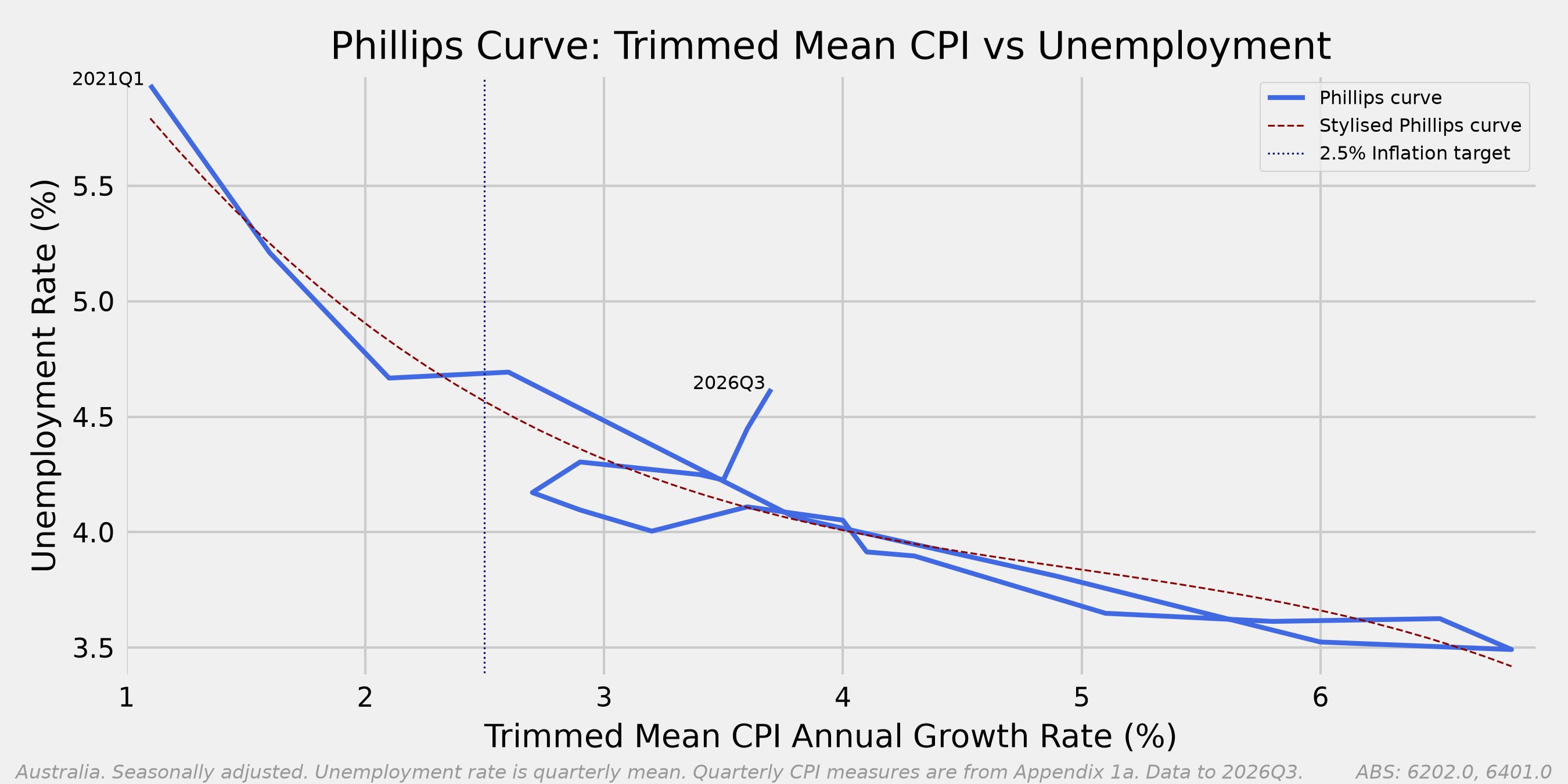
I often see people who argue that Austrlia is in stagflation. Yes there are issues at the moment. But they are nothing like the 1970s to 80s Stagflation period.



Why is inflation sticky and domestically driven? With zero productivity growth since 2019, wages can only rise about 2.5% a year without pushing up costs. Private wages are rising 3.1%.
That gap (about half a point) has been there since 2022. It has narrowed from about 1.5 points in late 2023, but not closed. Wages are rising faster than 2.5% inflation plus what productivity can absorb.
It's the same with public sector pay included (3.2%), but private wages are the better signal: they track the labour market far more closely than public pay.
The fix isn't necessarily slower wages growth. A return to even 1% productivity growth would lift the benchmark to 3.5%, and today's wage growth would sit below it.
[Note: corrects an earlier tweet from me, since deleted].


Why did the RBA take the narrow path, and why is it now talking tough?
A balancing clause that treats jobs as a short-run trade-off against inflation. Two definitions of full employment. And a NAIRU estimate in the low 4s that was always wishful.
Three errors, all pointing the same way. Trimmed mean inflation persistent at 3.6 per cent is the bill.
markthegraph.blogspot.com/20…


Here's some evidence. Two models, four specifications, all fitted to Australian wage and price data. Every one puts u* well above 4.25: between 4.6 and 4.9 at the June quarter 2026, where the chart ends. They're not independent, since they share the same data, but none comes close to 4.25.
The chart also shows unemployment below every estimate from 2021 onward, by more than a point at the 2022 low. That matches the inflation record. Unemployment sat around or below 4.25 for most of the past four years, and trimmed mean dipped into the band only briefly in 2025 before climbing back to 3.6, driven by domestic and services inflation. If u* were below 4.25, inflation should have settled at target with unemployment there. It hasn't.
u* is uncertain. But zero evidence is a stretch.


