

Interests: Data. Python. Economics. Social Policy. Politics. Australia. Caveats: Not financial advice. Opinions my own. Likes ≠ endorsement.
Canberra, Australia
Joined March 2012
- Tweets9.9K
- Following2.7K
- Followers5.9K
- Likes5K





Mark 🇦🇺 retweeted
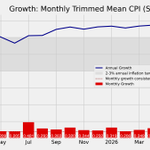
There are some signs of slowing in new dwelling price rises (its getting harder for builders to raise prices), but there are still more CPI items with inflation above 3%yoy and the trimmed mean inflation rate (which strips out big rises like petrol) seems stuck well above target.


Mark 🇦🇺 retweeted

CPI rose 4.3% in the year to September 2026
Find out more abs.gov.au/media-centre/medi…

Mark 🇦🇺 retweeted

We actually covered the S-1 filing announcement and what's in the filing here: xitter.cf/AGTPinsights/status/21…

Anthropic just made its S-1 public today. Here's what you need to know.
The filing went to the SEC on Oct 26 and Anthropic announced it on X. It plans to list on the Nasdaq Global Select Market under the ticker ANT. Goldman Sachs, Morgan Stanley and J.P. Morgan lead the deal. The price range and share count are not disclosed yet. The registration statement has not become effective, so no shares can be sold yet.
The financials are now public. H1 2026 revenue was $16.3B, up from about $1.1B a year ago. The net loss was $80.7B, but most of that came from accounting charges. The filing also shows a $974M operating profit and $131.7B in cash.
The compute bill is huge. Anthropic agreed to spend up to $120.5B with SpaceX's AI unit for access to Nvidia chips. Once all capacity is delivered, expected in December 2026, it pays about $3.1B a month. The deals run into 2029.
The filing also covers customers and control. Roughly one-fifth of revenue came from two customers. Founders keep 50.1% of the voting power through a founders' company. About 80 of the 261 pages are risk factors, including a warning that AI could pose catastrophic or existential risks to humanity.
Key numbers:
- ~250 customers pay over $10M a year
- 1,900 customers pay over $1M a year
- 11,900 customers pay over $100K a year
- $6.6M revenue per employee, per one investor's read
- $2.08 of revenue per $1 of compute, up from $0.40 in Q1 2025
Reports point to a listing in mid-November, with a possible valuation near $2T.

Mark 🇦🇺 retweeted

Q3 trimmed mean CPI
Last: 0.8pc
Mkt f/c: 1pc
Range: 0.9pc to 1pc
Core inflation expected to hold at around 3.6pc in the 12 months to September
Q4 headline inflation could well be lofty again with fuel costs leading the way; disinflationary pulse forecast to kick in only in CY2027
RBA has hiked 4 times already this year, but has openly flagged a further hike as likely…the path of least regret
Mark 🇦🇺 retweeted

The endless cost of living discussion is always selective and mostly focussed on elect/gas/petrol. Rarely discussed is how cheap some categories are eg kids tshirt $2.25!

Mark 🇦🇺 retweeted
There are obviously people struggling in Australia financially but 1/3 households struggling to put food on the table as these articles suggest is nonsense.

'Lucky country has become the hungry country': Foodbank Australia ift.tt/9HMYg18

Mark 🇦🇺 retweeted

It’s just very disappointing the RBA didn’t have the gumption to seriously tackle inflation in 2022 and 2023, sure the Middle Easy would be causing issues now but domestic inflationary pressures (of which there are still many) would have largely been contained.

Mark 🇦🇺 retweeted

This is a terrific and terrifying read from @insteconomics
Australia truly is the anti-Abundance nation
It's self-inflicted damage
We keep shooting ourselves in the foot and then wondering why we can't sprint anymore

Planning regulations add $42,000 in compliance costs to an attic renovation -- for no discernible benefit (other than as a make-work scheme for consultants).
stephenkirchner.substack.com…
Mark 🇦🇺 retweeted

Robert Hall and Michael Woodford have won the Nobel prize in economics. I discuss some of Woodford's work in the context of what Scott Sumner calls the Princeton School in this post stephenkirchner.substack.com…
Mark 🇦🇺 retweeted
THE RESERVE BANK ON 60 MINUTES TONIGHT
… suggests to me there’ll be a Melbourne Cup rate rise
60 Minutes: “Haven’t we done enough [to stop inflation from being high]?”
The RBA: “Not quite yet”

Mark 🇦🇺 retweeted

xitter.cf/alecgargett makes some great graphs, but these seem to be per-polling company.
You could also look at @Mark_Graph with items like xitter.cf/Mark_Graph/status/2108…


Mark 🇦🇺 retweeted

Daily dwelling prices from @cotality_au
This will not stop that RBA from raising rates in November. And it shouldn't.
If the inflation outlook is "materially worse" then a material policy response is warranted and a lone 25bp hike in September isn't enough.


Mark 🇦🇺 retweeted
Why did the RBA take the narrow path, and why is it now talking tough?
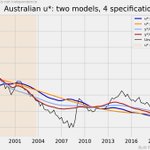
A balancing clause that treats jobs as a short-run trade-off against inflation. Two definitions of full employment. And a NAIRU estimate in the low 4s that was always wishful.
Three errors, all pointing the same way. Trimmed mean inflation persistent at 3.6 per cent is the bill.
markthegraph.blogspot.com/20…


Mark 🇦🇺 retweeted
Agree the NAIRU is the benchmark, and we both called estimates in the low 4s wishful at the time. I’m not arguing for strict inflation targeting either. The board should diagnose what’s driving inflation and respond accordingly. Full employment, properly defined as the NAIRU, is the goal. Price stability is how you achieve and sustain it. Where I differ is on treating jobs as a short-run trade-off against inflation. That’s what the current balancing clause invites, and it’s how Australian inflation stayed above target for so long (ignoring government subsidy fiddles at the edges).
And the government pushed hard for that "balanced" reading. In 2024 the Treasurer said rate rises had smashed the economy and framed the goal as fighting inflation without smashing growth. Bullock held the line that year, warning entrenched inflation would cost jobs later. But the pressure, the balancing clause and a wishful NAIRU estimate all pointed the same way.
Mark 🇦🇺 retweeted
Agreed, the 2–3% target hasn’t changed. What changed is how hard the RBA pushes toward it when unemployment is rising. A dual mandate builds in a short-run conflict: every step toward the inflation target costs jobs, and the jobs leg tells the bank to ease off. Equal weighting means the bank splits the difference. That’s the narrow path. The destination stayed the same. The slow speed of travel was set by the mandate.
The mandate was built to fix a 2016–19 problem, when policy was too tight. More recently policy has been too loose, and the mandate is part of the problem, not the solution.
It’s a big part of why Australia still had an inflation problem before the Iran war. And it’s why the RBA will now need to push unemployment above its sustainable rate to finish the job.
Mark 🇦🇺 retweeted
Independence covers the instrument, not the objective. The government set the objective, and it got it wrong. The jobs-inflation trade-off only exists in the short run, but the short run is where an equal mandate does its damage. It invites the bank to compromise: go slow, protect jobs, look for a narrow path, let inflation sit a little high. Then expectations drift, and the only way back is a recession. The jobs you protected at the start are the jobs you lose at the end. That’s a misaligned objective, and the government hog-tied the bank to it.