

Studying the origin and evolution of life on Earth to inform the search for life elsewhere in the Universe. Follow @NASASolarSystem, @NASAMars, & @NASAUniverse
- Tweets4K
- Following89
- Followers812K
- Likes3.2K



ALT The gray, cratered surface of Ceres fills most of the frame. Near the bottom left, one crater has small patches of much brighter material.

ALT A diagram of interior layers in Ceres. Beneath the cold surface and ice-rich crust is a reservoir of salty water, where water and gases released from the rocky core below mix with the organic molecules methane and carbon dioxide.


ALT This artist’s concept of exoplanet TOI 700 d depicts a bright blue, ocean-covered world marbled with white clouds. The planet is tidally locked to its star, leaving one side in constant daylight and the other in darkness, fading into the black background. The image is watermarked “Artist’s concept” and “Credit: NASA's Goddard Space Flight Center/Chris Smith (USRA).”


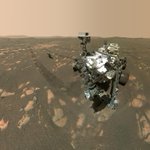
ALT A panoramic view of a rocky desert landscape under a perfectly clear sky around mid-day. Low hills lie along the horizon. In the foreground, the back end of the Perseverance rover fills the lower right side of the frame. A gray, cylindrical antenna sits atop the left side of the rover. At the center of the rover is a white, metallic cylinder with flat cooling fins radiating from the center. On the right side is a flat, hexagonal antenna pointed at the sky.


ALT Illustration of the Dragonfly robotic rotorcraft flying above the surface of Titan. Dragonfly has eight spinning propellers, several cameras, and landing skids similar to a helicopter.


ALT Satellite view of the northwest African coast, showing the Sahara Desert and the Atlantic Ocean. There are swirling green algae blooms in the water near the shore. NASA logo in the corner.


ALT At left is NASA’s Perseverance Mars rover, with a yellow circle indicating the location of the calibration target for the rover’s SHERLOC instrument. At right is a close-up of the calibration target. There are five circular disks on the top row. Along the bottom row are five swatches of spacesuit materials that scientists are studying as they degrade. Credit: NASA/JPL-Caltech/MSSS


ALT A landscape on Mars seen from above. On the left side is a cliff of ice layers coated in red dust. A reddish cloud of dust is flowing down the side of the cliff and billowing out onto the plain below.

ALT An illustration showing the Europa Clipper spacecraft above a regulation basketball court, showing that from end to end, the spacecraft is about the length of the court.


ALT An illustration of the International Space Station over a football field with "NASA" painted in the end zones. The space station and field are about the same size. Credit: NASA


ALT A close-up shows the side of the dusty Alpha Particle X-Ray Spectrometer (APXS) instrument on the Curiosity rover's robotic arm. The dust-covered instrument is about the size of a cupcake and is on its side, showing handwritten notes along the side. The rocky and sandy Martian surface is blurred in the background.

ALT Close-up shows a dusty, perforated metallic instrument on NASA's Curiosity rover, mounted among a network of bundled cables and mechanical components. The rectangular plate has numerous small circular holes arranged in patterns, with a central circular feature containing multiple lens-like elements. The surrounding wires are wrapped and secured with beige-colored fasteners. The entire assembly has a layer of Martian dust, indicating long-term exposure to the planet's environment.

ALT screenshot of a web application showing the current activity of antennas around the world that are communicating with spacecraft around the solar system.bAn icon representing a large antenna at the Madrid station is highlighted, indicating it's currently in contact with Europa Clipper.


ALT A diagram showing Europa Clipper's trajectory from Earth to Jupiter. The Sun is at the center, with planetary orbits depicted as red circles. The spacecraft’s path is shown in blue. Europa Clipper launches from Earth on October 14, 2024, then performs a Mars gravity assist on March 1, 2025, followed by an Earth gravity assist on December 3, 2026. After traveling through the solar system, the spacecraft reaches Jupiter and performs its orbit insertion on April 11, 2030. The diagram highlights key flybys and the overall curved path taken to reach Jupiter using planetary gravity assists.