

Can your GPU run that model? Find out in 10 seconds. Free VRAM calculator + no-hype hardware guides for local AI.
Joined June 2026
- Tweets444
- Following134
- Followers225
- Likes442







VRAMCalculator retweeted

Project Maya v1.1.29 is here, and it's a big one: MiniMax-M3.1-Flash now runs on Maya.
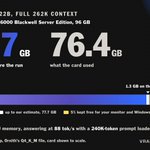
That makes three frontier open models you can run at home on your own GPUs: GLM-5.3-Flash, DeepSeek-V4.1-Flash and now MiniMax-M3.1-Flash, a 428B model with 23B active per token and up to a 1M context.
MiniMax gets its own engine, built by @needmorevram. We brought it up to the same standard as GLM and DeepSeek before shipping it:
- Runs on NVIDIA from V100 up, on Linux and Windows
- Fits itself to your PC: the setup picks the context your memory can hold, and the engine plans VRAM and RAM instead of failing
- A compact cache by default, so long contexts take half the memory with no loss in quality
- Pictures, tool calls and every one of MiniMax's thinking levels, with its own recommended settings out of the box
- The vision tower stays off your GPU until you send a picture, so the VRAM goes to the model
Huge thanks to @needmorevram, and to everyone who tests, reports and contributes to Maya. This is what community open source looks like.
Next up (WiP): our own Maya GGUF quants of MiniMax-M3.1-Flash, small enough for a 128 GB PC.
Link in the reply 👇


VRAMCalculator retweeted

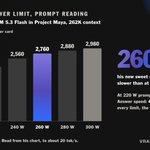
260w is my new sweet spot for 3090 cards in layer-split models.
When running GLM-5.3-Flash with Maya, 3090 power limits have little impact on decode, but prefill is another story - you go faster with more power, but marginally so.
Pick a curve, any curve.
HW 7x3090+128gb

VRAMCalculator retweeted
Project Maya v1.1.6 + v1.1.7 are out
• KV streaming: long contexts with the cache in RAM, 1M on one RTX 3090
• EXL3 + DFlash2 ~2x faster on two GPUs
• Faster CPU experts and INT8 prompts
• Windows: full speed in the background, fuller RAM tier
github.com/mw00/project-maya…

VRAMCalculator retweeted
New update is here!
- Apple Silicon is now supported
- NVFP4 Support, UD-Q4, UD-Q5, UD-Q6, UD-Q8
- Qwen3.6-35B-A3B is also now available
- Another 10%-20% boost
and more: github.com/Niko1221/Strata/r…

VRAMCalculator retweeted
Project Maya v1.1.1 to v1.1.4, four releases today:
-Sampled decode +13% on 4x RTX 4090
-Speed calibration keeps DFlash2 only where faster
-9-GPU fresh start 35.4 to 40.7 tok/s
-EXL3 works with DFlash2
-Windows + AMD fixes
github.com/mw00/project-maya…
VRAMCalculator retweeted
Release notes + download:
github.com/mw00/project-maya…
Also in this release: opt-in CORS and clearer Windows NUMA info

VRAMCalculator retweeted
One cool little trick we implemented from day 1 was keeping vision pinned to the ssd, and moving it to VRAM when required, then back to ssd
It introduces 1-2s delay on the vision to start to work, however it keeps as many experts as possible in VRAM when vision isn't in use 🏃

GLM 5.3 Flash is a 320B model. Z ai says it nears Claude Opus 4.8 at coding.
Project Maya runs it on two Tesla V100s with 30 GB of RAM: up to 40 tok/s on its author's own bench.
The cards hold the part every token needs and the most-used experts. RAM holds the next ones. The NVMe SSD holds the rest.
Its author, @PeasantSmith, ran Strata on a V100 first. Maya is the same idea for a stronger model, built around NVIDIA. On AMD or Windows, Strata is the one built for you today.
Strata, Maya, TensorFold: each built around one model or a few, while llama.cpp aims to run them all. Is local AI heading for one engine per big model?
vramcalculator.com/project-m…

VRAMCalculator retweeted

Windows now has sandboxing!
Microsoft released an open-source repo, mxc, for sandboxed code execution.
We collaborated with Windows to add mxc OS level sandboxing to Unsloth which adds just <100 ms of overhead.
GitHub: github.com/unslothai/unsloth
Guide: unsloth.ai/docs/new/studio/s…

VRAMCalculator retweeted

My latest!
4090D 48GB + 3600X DDR4 3200mhz 128GB
xitter.gq/sorek_UK/status/210789…


VRAMCalculator retweeted
- Output t/s: 75.8 -> 80.0 (+8% aggregate)
- Prompt t/s: +26%
- Parallel requests (4 max) 👀
- Old CPU support: Sandy / Ivy Bridge, Xeon E5 v1/v2, Bulldozer, Nehalem / Westmere
- Old GPU support: P40, P100, GTX 10, V100, Titan V, Instinct MI50 / MI60, Radeon VII
- Intel Arc support 👇
VRAMCalculator retweeted

I'm testing Qwen3.8 Flash next GGUF for agentic coding.
So far it's not pretty
UD Q2K XL and Coder are both largely underperforming the original model, and generate a crazy amount of tokens
I'm now running UD Q4K XL. I'll also run one more GSQ-RCO.
Full results next week
VRAMCalculator retweeted

My fork is now called 'Strata-Dirigo', because I've added a lot of features. Intel Arc support coming soon: I have the Arc Pro b70 I just have to install it and get going. Hopefully this will allow me to support the Alchemist generation as wel as Battlemage. github.com/rwkeyes/Strata_Di…

VRAMCalculator retweeted
I tested 11 standard GGUF quantizations of Qwen3.8 Flash Next, from Q4 to Q1.
On these single-turn, non-agentic evals, every standard GGUF I tested retained >95% of BF16 accuracy. Even the IQ1 models held up surprisingly well.
Token efficiency degraded much more clearly. The quantized models generated 14% to 157% more output tokens than BF16 on the same workload.
So for these non-agentic evals, accuracy alone shows relatively little degradation, while token efficiency gives us a stronger signal that quantization is affecting the models.
The remaining question is how this translates to long agentic trajectories. I’m running those evals now (but not for all the models) and will publish the results next week.
Details: kaitchup.substack.com/p/qwen…
(as usual, don't interpret these results as a ranking)

VRAMCalculator retweeted

Claude Opus 5.5 is here. There are really impressive benchmarks.
Anthropic made frontier-level agents dramatically cheaper to keep running too!
Opus 5.5 vs Opus 5
💰 input: $5 → $4/M
💰 output: $25 → $20/M
🔄 cache reads: $0.50 → $0.20/M 👈
⚡ output: 30%+ faster
📉 typical task cost: ~40% lower
That cache number matters.
Anthropic says cache reads make up most costs in agentic + coding workloads.
And the model apparently needs fewer turns/tokens to finish the job too.
One early test
🧑💻 200,000-line codebase audit
Opus 5: 20+ hours
Opus 5.5: under 3 hours
…while Opus 5 used 2.5× more tokens.
Another tester migrated a 680,000-line codebase in under a day.
Anthropic even says default-effort Opus 5.5 beats GPT-6 Astra on FrontierCode at roughly 1/5 the cost per task.

VRAMCalculator retweeted

we launched the most comprehensive ai performance engineering repo in the world last week
now we'll be posting every single resource
this is Wafer's ai performance engineering series
save this as your starting point. links in thread 🧵
part 1: "All About Transformer Inference" from How To Scale Your Model.
- the authors cover the computations, memory traffic, and serving decisions behind transformer inference:
- arithmetic intensity of linear layers and attention across prefill and decode.
- kv cache sizing by layer count, kv heads, head dimension, sequence length, and precision.
- the compute/hbm bandwidth crossover and how batch size and quantization shift it.
- decode latency and throughput bounds from parameter bytes, kv bytes, and hardware bandwidth.
- weight reuse through batching and diminishing throughput gains as kv traffic grows.
- gqa, kv quantization, and PagedAttention, including the memory costs each addresses.
- model sharding, kv placement, and collective communication overhead.
- continuous batching, prefix caching, and disaggregated prefill/decode.
the worked problems connect model dimensions to deployment decisions like memory capacity, workload distribution, and expected performance under the stated assumptions.

VRAMCalculator retweeted

I've asked Astra to read the DeepSeek v4.1 Flash paper and compare it to the original Transformer architecture in 3D - you can zoom in an inspect each element side by side. Things have changed quite a bit.
Try yourself: transformer-architecture.pet…
VRAMCalculator retweeted

Deepseek V4.1 Flash (552B MoE) on par with Qwen 3.8 Flash Next on Artificial Analysis Intelligence Index!
Only 2 points behind GLM 5.3 Flash, while sitting 6 points ahead of Qwen 3.8 27B.
But Qwen 3.8 Flash Next (125B A6B MoE) can run on a single RTX 3090/4090


DeepSeek V4.1 Flash overtakes DeepSeek V4 Pro 0813 as DeepSeek’s new flagship model with a score of 40 on Artificial Analysis Intelligence Index. At just 552B parameters, it outperforms the Pro (1.6T) model while costing ~4x less per token, placing it just short of the Intelligence vs. Cost Pareto frontier because of its verbosity
@deepseek_ai has released DeepSeek V4.1 Flash, the successor to DeepSeek V4 Flash 0731. This is a 552B model features a new causal Encoder–Decoder architecture, allowing it to have just 8B active parameters for input and 16B active parameters for output.
On the first-party API, DeepSeek V4.1 Flash is priced at $0.30 per 1M input tokens and $1.20 per 1M output tokens, with cached input tokens priced at just $0.006 per 1M tokens, a 98% discount. Off-peak pricing provides a further 50% discount across input, cached input, and output tokens. V4.1 Flash is ~20% cheaper than DeepSeek V4 Flash 0731 and ~4x cheaper than DeepSeek V4 Pro 0813 while delivering a higher performance.
Key results:
➤ DeepSeek V4.1 Flash makes gains in agentic capabilities and long context reasoning. DeepSeek V4.1 Flash scores 27% in Terminal-Bench v4.0, more than double DeepSeek V4.0 Flash’s 27%. Its GDPval-AA v2 rises 164 Elo points from 1468 to 1632, placing V4.1 Flash ahead of Kimi K3 (1584). DeepSeek V4.1 Flash also scores 84% on AA-LCR v1.1, at the same level as GPT-5.6 Sol (84%) and Gemini 3.8 Flash (84%). With a 1M token context window, this makes it a strong option for long-document and large-repository work at flash-tier pricing.
➤ DeepSeek V4.1 Flash takes first place on AutomationBench-AA with 69%, equal to GPT-6 Astra (69%) and slightly above Grok 4.6 (67%). AutomationBench-AA measures agentic workflows across 657 tasks spanning 39 SaaS applications including Salesforce, Jira, Gmail, Zendesk and Google Sheets, scoring whether a model completes the objective without tripping a guardrail. DeepSeek V4.1 Flash gains 15 percentage points over DeepSeek V4 Flash 0731 (54%), sitting 12 points above DeepSeek V4 Pro 0813 (57%) and 7 points above GLM-5.3 (62%).
➤ DeepSeek V4.1 Flash is one of the most verbose models we’ve measured at 89k Tokens per Intelligence Index Task. That is 25% more than Z AI's flagship GLM-5.3 (71k), 29% more than GLM-5.3-Flash (69k), and 62% more than DeepSeek V4 Pro 0813 (55k). It uses more output tokens than even the frontier models, including Fable 5.1 (78k) and Claude Opus 5 (73k).
➤ Despite such verbosity, DeepSeek V4.1 Flash still costs just $0.27 per Intelligence Index task. This is primarily driven by its low pricing at $0.30 per 1M input tokens and $1.20 per 1M output tokens, with cached input tokens priced at just $0.006 per 1M tokens, a 98% discount. That is ~7x below both GLM-5.3 ( $2.01) and Kimi K3 ($2.00), and ~2.5x below DeepSeek V4 Pro 0813 ($0.67).
Additional model details:
➤ Context window: 1M tokens
➤ Pricing: $0.30 / $1.20 per 1M input/output tokens on DeepSeek's first-party API, with a 98% cache hit discount ($0.006 per 1M cached input tokens)
➤ Input modalities: text and image
➤ Size: This is a 763B total parameters, 8B active parameters input and 16B active parameters output
➤ License: MIT
➤ Providers: DeepSeek first-party API
