

aggressively curating (see reposts) current: @superhuman Past: @copy_ai @futurism Watch my videos below 👇
New York City
Joined November 2011
- Tweets4.4K
- Following2.3K
- Followers2.2K
- Likes49.3K







Austin Calvert retweeted

I actually agree with a lot of what @poteto is saying except for the central point. IMO most people don't have actual software factory systems. They've just made it much easier for people to ship with AI, so they assume the category doesn't exist. That's more a lack of vision than anything else.
Our conceptualization of a software factory is a system where every piece of work goes through the same stages to standardize the process not the work output.
For us, this standardized process begins with what we call a signal. This is anything that tells you how your software should evolve, including the first signal that your software should exist at all. A Slack thread, a Linear ticket, a Sentry alert, a failing CI job, a tweet, someone's idea.
There's two ways in for a signal. A person picks it up and builds it with Droid, or a workstream picks it up on its own, triages it against a goal someone set, and has droids write the spec and open the PR. Most work still starts with a person, but a growing share comes from workstreams.
Then every change goes through the same checks no matter who or what wrote it. Droid review, security review, a risk judge that can't see who wrote it, CI, and an agent that QAs it on a live preview. Your validation has to be really high quality whether a human or AI built it. The goal of validation is to hillclimb your "regret-free merge rate" until you can automatically merge most changes (or fix them until they can be automerged).
Then it ships, and when something breaks in production we trace it back to the PR that caused it. That becomes another signal. It's also how we know if the checks actually work. If the risk judge approved something that later broke, we find out.
It's the same way we let self-driving cars on the road. Nobody just flipped a switch. We agreed that once they crashed less than human drivers, they could drive. Do the same thing with code. Once AI-written changes break things less often than human ones, and you can actually measure that, you let them merge.
That doesn't mean you turn on automerge tomorrow. Most of our changes still get a human stamp. But once you have automerge, workstreams and a risk score together, you basically have software that improves itself from the signals you choose to track.
The human element becomes obvious if you have a system like this. People remove themselves from the actual process line and begin to define the rules by which the process operates. What to watch, goals and owners, skills, review guidelines, and how much autonomy each workstream gets. They're the regulators.
I think the 1920s factory that a lot of people picture is the wrong idea. That was people doing the same motion on a line all day. This is closer to a Star Trek replicator. You say what you want and it gets made, because the patterns are already stored and how things get made is the same every time, and checked every time.


Austin Calvert retweeted

swarms organize themselves. we mapped 6 layers of activity across 6 rounds, 1800 chat sessions in ArkenOS:
L1: research mission + environment
L2: automated checks + benchmarks
L3: decisive experiments
L4: peer collaboration
L5: skills + memory updates
L6: human intervention
we're trying to understand how activity migrates between layers. around round 4, experimental activity thins out while peer collaboration picks up. agents seem to shift from running experiments to exchanging findings, resolving uncertainty, and coordinating what to investigate next. human intervention stays sparse throughout.
we're beginning to see something resembling an endogenous division of scientific labor. agents deciding when to experiment, when to collaborate, and when to consolidate what they've learned.
the most interesting swarm-scaling variable might not be swarm size, but how intelligence reorganizes itself across the research process.


Humans use Linear, Jira, and Trello to coordinate work. Turns out agent swarms need something similar. So today, we're introducing Projects in ArkenOS!
Agents can now create their own Projects, break down a research mission into smaller workstreams, and track tasks on Kanban boards. As experiments branch out, agents can create new tasks, update progress, track dependencies, and coordinate who's working on what.
The goal is to let swarms organize their own research, without a human having to micromanage every agent. More autonomy, less orchestration overhead, much bigger research missions!

Austin Calvert retweeted

hot take: you don't need a software factory, and i don't love the term. it's just marketing
all you need is good software engineering and investing your tokens in the right places. the more deterministic the better (and token efficient)


Austin Calvert retweeted

New Post: Designing an Always-On Agent
How to build agents like Grok Bot, Muse and Instinct
rubriclabs.com/blog/always-o…

Austin Calvert retweeted

Elon Musk on how to have a first principles mindset:
"I think it's also important to reason from first principles rather than by analogy. So the normal way that we conduct our lives is we reason by analogy. We're doing this because it's like something else that was done, or it's like what other people are doing.
It's kind of mentally easier to reason by analogy rather than from first principles. But first principles is kind of a physics way of looking at the world, and what that really means is you kind of boil things down to the most fundamental truths and say, okay, what are we sure is true, or as sure as possible is true, and then reason up from there. That takes a lot more mental energy."

Austin Calvert retweeted

people who think they are super senior are constantly fucking this up. You don’t know more than the clanker brother let it cook

Austin Calvert retweeted

We must balance the mundane with the exceptional. If we don’t do this we die
Austin Calvert retweeted

to grok where $$ is going:
you can do deep diligence/DCFs/financial models to 2 decimal points (to prove you have a sense of humor w/false precision)
OR
like me you can consume copious amounts of culture/content: TV/graphic novels/video games
ART imitates LIFE imitates ART👇


Austin Calvert retweeted

we have a winner for the most absurd AI startup ever
this Peter Thiel backed company uses AI robots to stab fish in the brain so they taste better and last up to 3x longer
it's called Shinkei and it modernizes a centuries-old Japanese technique
dozens of Michelin-star restaurants are already lining up to buy the fish
here's how it works:
> the problem is when a fish gets caught, it usually just suffocates on the boat
> that stress floods the meat with hormones and lactic acid, which hurts the flavor and texture
> the old Japanese fix for this was spiking the fish through the brain right after the catch, which stops all that
> but doing it by hand is impractical for most American fishing crews
> so Shinkei built a fridge-sized robot that sits right on the boat's deck
> the crew feeds in a fish and AI identifies the exact species, so it knows exactly where the brain and gills are
> the robot then drives the spike through the brain and cuts near the gills in about 7 seconds
> the fish goes into an ice slurry so the blood drains out
> so the fish doesn't sit there stressing out, and that tasty flavor and texture is preserved
example number 5,392,417 of how AI can be applied to literally anything

ALT A gloved fisherman on a boat feeds a live salmon head-first into the steel intake of a white Shinkei Systems robot, with the ocean behind.


Austin Calvert retweeted

As I've said before, your personal website is the new resume
LinkedIn shows a list of titles; your personal website shows your taste, your thinking, your actual work
You don't need to be confined by the existing social media platforms

rich personal websites possibly with your first & last name domain or even with an identity like signull will matter a lot more because when personal agents browse the internet for a variety of use cases, that context will be highly ranked.
first & last name domains + a rich website will be the new facebook profile. imagine a match maker agent finding you because you’re single, or a job search agent because you’re looking for a gig, or an agent that finds you ppl to play tennis with, etc.
discoverability for agents will be huge & networks like insta & linkedin will have not have huge incentives to open this up for other agents than their own, so it’ll matter again a lot more.
Austin Calvert retweeted

"Most hardware engineering is actually software engineering in disguise."

12 years ago I founded Boom, as a software engineer doing hardware for the first time. I’m probably the least handy founder in hard tech. My 12 y/o son does my soldering and 3D printing for home projects, and I’ve struggled with imposter syndrome the whole way through. What business does a software guy have building supersonic jets and turbines?
More than a decade in, the most insane realization is that software is the key to reaccelerating hardware engineering. But in a way that I don’t think is widely understood or implemented, even in the burgeoning hard tech community.
Most hardware engineering is actually software engineering in disguise. It’s spreadsheet “code,” engineering calculations done as one-offs. Eg wing structural loads in, spar sizing design out. Thermal loads in, air conditioning system sizing out.
Everything is a calculation, and calculation is software. But these calculations are done essentially by hand, as if we are doing arithmetic but have not yet discovered algebra.
Hardware engineers have baby software, built in spreadsheets, the kind of crappy software I wrote as a kid before I understood architecture, unit tests, APIs, version control, and everything else that makes modern software good.
Our airplanes and engines are built with the software sophistication of a script kiddie.
So what we tell our engineers: don’t design the hardware, design the *algorithm* for designing the hardware. And take the algorithm seriously—as an algorithm and as a first-class engineered software system.
Never design a piece of hardware, such that you couldn’t redesign it tomorrow with a different set of assumptions.
This all sounds obvious, yet our experience at Boom is that it changes everything.
Ten years ago we couldn’t afford to build much software. We had a small team—and there were few software engineers with the curiosity, brilliance, and vision required to learn hardware engineering.
But now AI changes the equation. Now everyone can code. The software engineers define the architecture. The hardware people bring the physics and engineering know-how.
We have a turbomachinery design tool that lets one engineer do in realtime what previously took 100 engineers six months. Another tool auto-generates 65% of entire aircraft structure. I’m sure we’ll figure out the other 35% too. Eventually these should not be multiple tools, but one integrated physics model of a complete vehicle, airframe and powertrain.
The results speak for themselves. A boomless supersonic airplane built by 50. A full scale supersonic turbine made by 150. And with this approach, I don’t think we’ll need that many more people to build and certify a supersonic airliner.
You don’t need a big team to build big things—not when everyone on the team is a software engineer.

Austin Calvert retweeted

This is f*cking insane. Microsoft CEO Satya Nadella:
"Business applications, that's probably where they'll all collapse in the agent era. They are essentially databases with a bunch of business logic
The business logic is all going to these agents. And once the AI is where all the logic is, people will start replacing the backends"
In just 2 minutes, he explains why the software your company pays for every month is about to become a storage box the agents write into
Apps → Copilots → Agents → Software That Runs Itself
An app makes you click through its screens and follow its rules
An agent skips the screens, updates every system at once and keeps all the logic for itself
Anyone can learn one more app, almost nobody is learning to run the agents that replace it
Save and watch it today
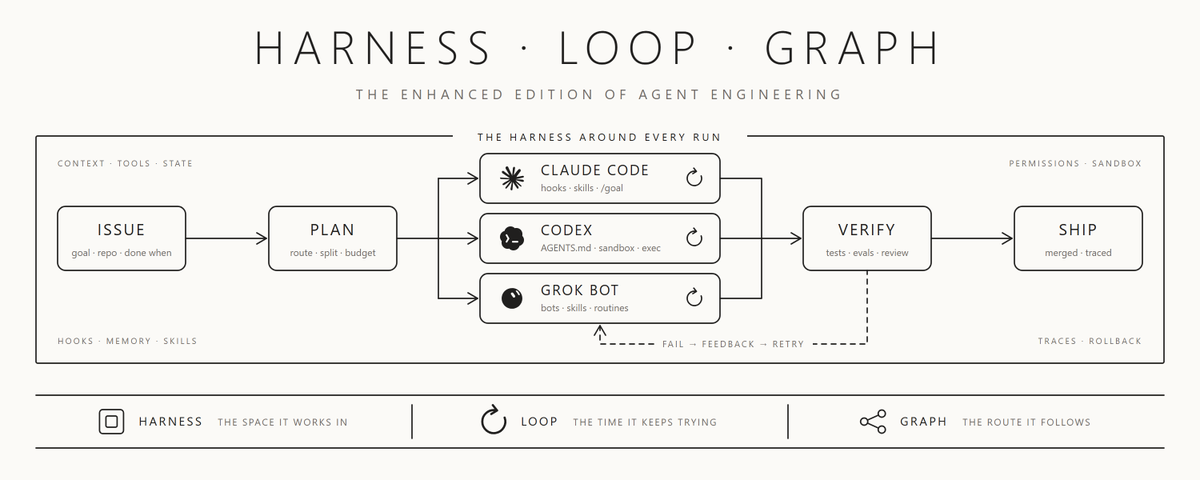
Then read how to build the agents that take over those apps in the harness engineering guide below ↓

Austin Calvert retweeted

Introducing Arete-27B: Qwen3.8-27B, post-trained to reinforce Western values.
Chinese open models are currently the strongest available, but they ship with state-aligned behavior in the weights. We built an 803-prompt eval across seven value categories, including freedom of expression, democracy, and privacy, and measured how often a model adopts China’s party line.
After fine-tuning on roughly 53 million tokens, Arete-27B's propaganda rate fell from 22% to 1%, in line with the Western models we tested. Its Hermes Bench score shows no significant performance tradeoffs.
The values in an open model are one fine-tune away.
Our eval, weights, and training data are available now along with the full blog post: nousresearch.com/arete