



Ayoub (@adbayb) header
Ayoub (@adbayb) profile picture
Joined October 2015
Photo by Ayoub (@adbayb)Photo by Ayoub (@adbayb)Photo by Ayoub (@adbayb)Photo by Ayoub (@adbayb)Photo by Ayoub (@adbayb)Photo by Ayoub (@adbayb)
Ayoub retweeted
Much love to the Solid team and congrats on launching Solid 2! Cursor has largely completed this migration from Solid to React. We also have since converted all our scss and Tailwind to @stylexjs, in both Cursor and in @bot. The new agents window is 99% React, with a few stragglers left that we have yet to migrate. The big motivation for this migration was for perf and maintainability reasons. We have seen that in practice, it is actually quite easy to create perf footguns for yourself in signal based approaches when reactivity causes a large amount of accidental fan out in large and complex apps. It probably was a skill issue. But in the age of agents, choosing what pitfalls you're okay with is an important decision. I think it's fair to say that every UI framework has its pitfalls and that no perfect one exists yet. For us, React was the most known quantity, and we found that solving its problems is actually quite straightforward and boring: exactly what you want when you're trying to ship! Something interesting I also observed is the uncanny valley effect of non-React frameworks looking like React. I think it confuses agents, because in my experience, agents were quite bad at writing good Solid code. Everything ended up being accidentally tracked which caused so many perf problems. React Compiler solves most of your perf problems with over-rendering. The remaining cases just take some manual memoization or refactoring/composition, which an agent can easily do. The nice thing about useEffect is that it's like an unsafe {} block in Rust: it shows me at a glance where the problems are. @bot (which is 100% React) is built on Dune, our in-house, agent friendly React framework for desktop apps, which actually bans useEffect outright and only exposes it indirectly through framework-provided hooks. Highly recommend setting something like that up for yourself!
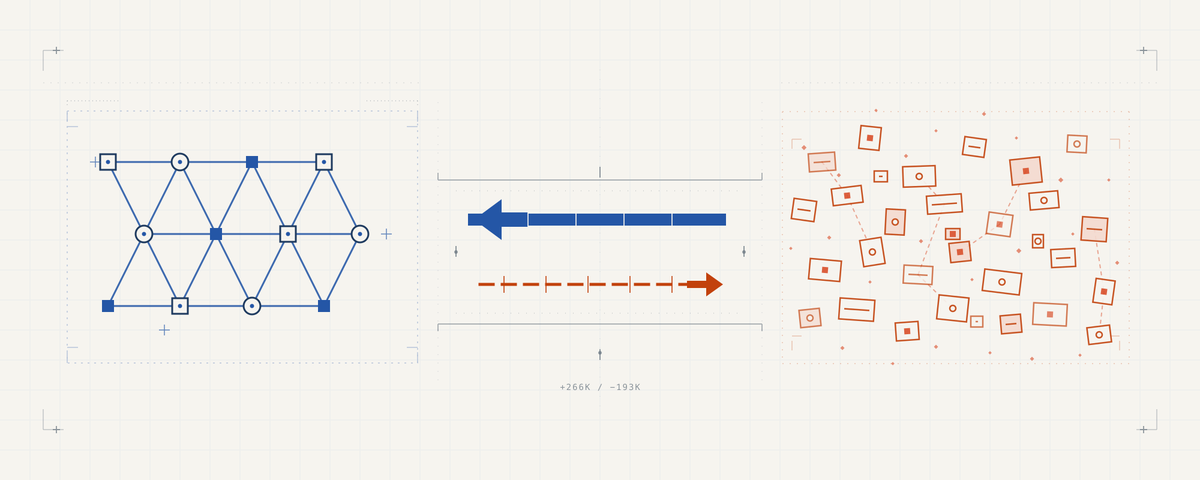
The most famous AI tool migrated Solid to React with an agent: +266K/−193K edits. That direction is easy. React's model makes the author hold all the complexity; Solid's graph holds it for you. React asks you to predict. Solid asks you to read.
57
50
18
892
386,895
Ayoub retweeted
🦀 Rslint v0.6.0 is here: run ESLint plugins directly! - Use existing ESLint plugins in your Rslint config - 40+ new rules across TS, Jest, a11y, Promise, and React - Unified diagnostics and autofix support
3
15
118
5,596
miam miam. Le code source de Claude a fuité. Festin. J'ai analysé le source leak de Claude Code. Ce qu'Anthropic construit en secret est bien plus fou que ce qu'ils annoncent. Claude Code n'est pas un assistant de code. C'est un OS pour agents. Voici ce qui se cache derrière les feature flags. Il y a une variable dans tout le codebase : if (USER_TYPE === 'ant') return true Les employés Anthropic ont accès à TOUT. Kairos, Advisor, multi-agents, sandbox. Vous utilisez la version démo. Eux utilisent le vrai produit. -> KAIROS : l'agent qui agit sans qu'on lui demande. > Il se réveille seul (SleepTool) > Il vous notifie (PushNotificationTool) > Il vous envoie des fichiers (SendUserFileTool) > Il distingue ses messages "normaux" de ses alertes "proactives" Claude qui tape sur votre épaule quand il a fini. Pendant que vous dormez. -> ADVISOR : un Claude qui surveille Claude. Un second modèle tourne en parallèle du modèle principal. Il observe. Il peut interrompre. Il injecte des corrections via des blocs API non documentés publiquement (advisor_result, advisor_redacted_result). Un méta-Claude. En prod. Maintenant. Pour les ants. -> PLAN MODE V2 — le nombre d'agents parallèles est tiérisé par abonnement. Free/Pro : 1 agent Max 20x / Enterprise / Team : 3 agents Vous payez pas juste pour des tokens. Vous payez pour combien de Claudes travaillent en même temps pour vous. -> Le mot ultraplan dans une conversation déclenche une session spéciale côté serveur. Un keyword magique. Dans le code. Hardcodé. Qui change le comportement du modèle. -> SANDBOX : @anthropic-ai/sandbox-runtime, Un package npm interne. Restrictions filesystem, réseau par host pattern, callbacks sur violation. Anthropic peut faire tourner Claude dans un environnement totalement isolé. L'infrastructure pour des agents en prod dans des environnements hostiles existe déjà. -> WILLOW MODE : Claude sait quand vous revenez après une longue absence. Context > 100k tokens + 75 min d'inactivité = il détecte votre retour. Trois variantes A/B : dialogue bloquant, hint discret, hint v2. Il gère la reprise de conscience de la conversation. -> BRANCH : /branch fork une conversation à n'importe quel point. Nouveau sessionId. Champ forkedFrom pour tracer la parenté. Git. Mais pour des conversations avec une IA. -> Et le easter egg : un système d'animaux de compagnie ASCII avec des raretés (common → legendary), des chapeaux, des stats nommées. Les espèces sont obfusquées en hex dans le source pour ne pas apparaître dans les grep de canary strings des builds. Ils ont caché un Tamagotchi dans Claude Code. Avec soin. Ce que tout ça dit vraiment : Anthropic ne construit pas un meilleur chatbot. Ils construisent un système d'exploitation pour agents avec scheduling, isolation, fork de contexte, supervision inter-agents et boucles proactives autonomes. Le produit que vous voyez est le tutoriel. @MistralAI faites un mix de ce bijoux avec Qwen et épatez-nous.
Claude code source code has been leaked via a map file in their npm registry! Code: pub-aea8527898604c1bbb12468b…
41
95
10
880
187,540
I'm Boris and I created Claude Code. Lots of people have asked how I use Claude Code, so I wanted to show off my setup a bit. My setup might be surprisingly vanilla! Claude Code works great out of the box, so I personally don't customize it much. There is no one correct way to use Claude Code: we intentionally build it in a way that you can use it, customize it, and hack it however you like. Each person on the Claude Code team uses it very differently. So, here goes.
1,300
6,902
1,284
54,131
8,249,890
> Asks if 'if err != nil' is really that bad > Screenshot example shows accidental fallthrough from error case to success case Do we really need to discuss further?
This post is from a suspended account. Learn more
45
145
6
2,538
245,158
At @framer, we've made React hydration 50%+ faster for lots of sites when using Suspense to fetch data. The surprising part: We did that by... adding more Suspense tags. Why does it make hydration faster? Let's explore🔎:
2
6
92
10,119
Yessssss! Node just shipped the ability to run TypeScript files directly!
87
417
76
3,222
217,941
It's never been easier to make beautifully styled text for your CLI. Node's built-in 'styleText' is NICE
26
53
6
941
72,634
Okay, listen. If you're going to fetch in useEffect(...), you should at least make sure that you're handling: - Loading states - Error handling (rejections & HTTP error codes) - Race conditions & cancellation This isn't over-engineering. It's the minimum code to prevent bugs.
72
156
26
1,526
140,758
All PM templates from my Google Drive are now free for everyone 🎁 The extended edition: (1/4)
61
371
11
3,755
1,056,789
My books are free to read online: – Exploring JavaScript (ES2024 edition) – Deep JavaScript – Tackling TypeScript – Shell scripting with Node.js Retweets appreciated! exploringjs.com/
9
193
5
484
42,476
If you care about security for your NextJS app, stop using top level "use server" - it's way too easy to leak data Top level "use server" creates endpoints for all exported functions, even if they are never used on the client One accidental export can cause a ton of damage
59
123
58
1,175
298,044
Problem: Choosing a React state library is hard. Solution: Consider the tradeoffs. Here are 6 key tradeoffs, with examples: 1. General vs Specific General: Redux, Zustand, Jotai. Specific: React Query, Apollo. These are specifically designed for handling data fetched via HTTP. 2. Mutable vs Immutable Immutable: Redux, Zustand. Like plain React, you must provide an updated copy of state instead of mutating state. Mutable: Valtio, React Query. You can directly mutate state/cache. 3. External vs Internal External: Redux, Zustand, Jotai. State can be accessed outside React. Internal: Some state solutions are only available inside React components via hooks. React's built-in context is an example. 4. Auto vs manual render optimization Auto: Mobx and Valtio automatically optimize renders. Manual: Many other tools like Redux and Zustand require manual render optimization (for instance, via selectors). 5. One store vs multiple One store: Redux (typically), React Query. Multiple stores: Zustand, Jotai, Valtio. 6. Protected vs unprotected Protected: Redux, Zustand. You expose a "coarse grained" API that decides how it can be changed. Unprotected: Jotai, Valtio. Callers can change the state in any way.
21
27
2
301
44,362
Hey you - with the big React Router app - you should check out the new "Fog of War" feature released in v6.24.0 yesterday which allows effectively infinite scale for your app. It's also very useful in micro-frontend and module-federation architectures. github.com/remix-run/react-r…
5
12
7
78
20,509
Introducing Million Lint 1.0: A VSCode extension that automatically fixes slow React code for you! It's like ESLint, but for performance!
98
345
34
3,289
343,717
Great news for those extending base TypeScript configs Soon we should be able to use relative paths to the "final" config file ${configDir} placeholder Previously it was confusing, and you had to duplicate many fields in the child configs to use relative paths
3
17
3
116
20,431
Introducing Elysia 1.0「Lament of the Fallen」 Featuring: - Sucrose - Rewritten static analysis - Improved startup time up to 14x - Remove ~40 routes/instance limitation - Faster type inference up to ~3.8x - Eden Treaty 2 - Strict response error check ↓ Link below ↓
26
151
25
921
99,478
The cost of distraction is the person you could’ve become. If you suffer from distraction, read this. My Deep Work routine:
82
1,088
26
8,088
3,278,627