

design + code @vana | folly ~ persist | mise en scheme | @idiomata_
Northernmost South
Joined February 2009
- Tweets15.6K
- Following1.2K
- Followers1.1K
- Likes42.7K




Pinned Tweet
The instant wherein that supreme quality of beauty, the clear radiance of the esthetic image, is apprehended luminously by the mind which has been arrested by its wholeness and fascinated by its harmony is the luminous silent stasis of esthetic pleasure.
— James Joyce


The world runs on headlines, but scenes run on idioms that unfold into infinite tokens

How to capture attention:
Fifteen years ago when we were building RethinkDB it was on top of Hacker News all the time. To this day ppl remember this and maybe once a month someone asks me for help with launching their project.
It worked like this. I would think of an HN headline first, then we'd build the next product version to do whatever the headline promised. We'd submit to HN and it would either rise to the top or it wouldn't. Then we'd do it again. This loop taught me a few things which I use to this day:
1. It RL'ed me to generate good headlines. It's a skill you can develop through trial and error. I can maybe distill it to some rules of thumb, but a lot of it is, does it sound right? Is the rhythm right? Does the headline “hit the spot”? Not easy to explain.
2. I became headline-pilled. The world runs on headlines. People will grant you maybe 15 tokens of attention. Unless they feel there is some irreducible essence captured in these 15 tokens, they’ll move onto something else. This is true of your boss, your investors, your colleagues, your employees, your customers, social media audiences, even old acquaintances you randomly bump into. “So… what’s been going on in your life?” You only have 15 tokens, i.e. a headline, to answer this question.
3. Unless you already think in headlines, you can't build something and come up with a good headline post-factum. It just doesn't work out well. If you do that, either the headline will be true but boring, or it will be enticing but not credible. You've got to come up with a headline first and build towards it.
4. Working this way prevents feature creep. You build the minimum feature set necessary to make the headline credible. If smtg doesn't serve the headline, it's out. Once you have enough to make the headline credible, you ship. And headlines are by definition short, so your development cycle becomes very nimble and efficient.
5. It makes time-boxing easy. "Headline goes out by Sep 15th (or whatever), we gotta build enough to credibly share it with the world. Ready, set, go." This preempts all the debate about sprints, estimates, methodologies, prioritization, and so on. You just loop: headline -> build -> ship, headline -> build -> ship. It makes the development process really smooth.
In the age of Codex when building is cheap, this becomes even _more_ relevant. People are DDoS'ed with information, and it will only get worse. So a headline is all you get. You can make much more ambitious headlines come true now, but you still only get 15 tokens before ppl scroll past you.
Btw, once you master this idea a whole world opens up. You can play with violating these rules in a hundred ways and still capture attention. But not easy to do that until you've mastered thinking in headlines first.
Callum retweeted

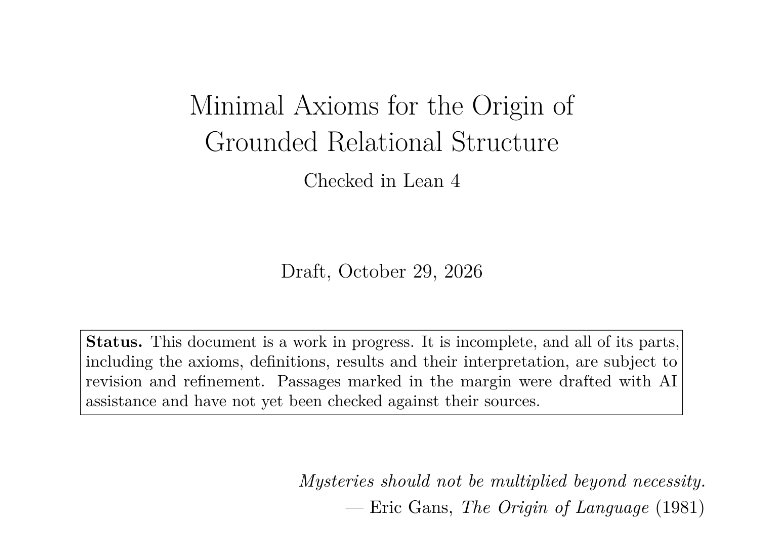
This mid 20 something loves Bouvard retweets, and has been working on an idea people interested in Adam’s work or GA might find useful: github.com/baartmans2/origin…
(this is mostly vibe coded, and with my startup taking most of my time, collaboration would be great).

In the future, everyone will be famous for 15 tokens
"A headline is 15 tokens; that's all you've got" @spakhm
That is, you have about 5-10 words


This came out of recent readings + logging fragmentary notes & thoughts: xitter.gq/callumflack/status/211…

Studying "Center" provides an answerable vocabulary of coordination that is eerily similar to LLM coding techniques (ie. coding in English): claim, proof, bearer, boundary, owner, sort, bind, oblige, invoke…
"Someone has to go first" = people provide the covenant. So the nth question is always who provides the judgement?

Callum retweeted

Desire is relationally mediated, and so not only can you literally not take “the” human out of the loop—but, the loop would not exist were it not for a second person, who, through direct relationship, invites new proximal goods. Form follows function, final and formal causes exist, etc. Until technologists, entrepreneurs, and policymakers take Thomist metaphysics seriously, we’re not going to make it to the other side of this period of transformation.

States are byproducts. Polanyi would say something like some things are understood by attending thru their particulars to the whole they compose. When we turn those particulars into separate objects of scrutiny, we can disrupt the integration that gives them meaning.
Language can guide us to understanding but can't substitute for it.

Ok, for the dozen people following me for NERD stuff, here's my opinion on why aiming for antifragility is bad:
brianlui.dog/antifragilebad.…
Callum retweeted

Tyler Cowen’s Strongest Book Recommendations, 2003-2026 marginalrevolution.com/margi…


Callum retweeted

I'm experimenting with a new form where I write flowery nonsense and don't fact-check.
logofftom.substack.com/p/in-…
🤖 Made with AI

Here's a few idiomatic prompts I keep reaching for:
callum.website/prompt-framin…


I feel like we need a place to share all of our various prompting “power phrases”. 140 chars or less, not long enough to be a skill but undeniably useful.
“Is that the best you can do?” @bitsweat
“Give me irrefutable proof this works now” @thorstenball
“How can we pokayoke this error type so it never is introduced again”
Others?
Made this into a skill. Mostly b/c it's easier than pasting in the article.
skills.sh/callumflack/skills…

Added "What are we not even considering building here because it used to be too much work—and would it be worth building now?" from @danluu 's excellent "We should be more ambitious" article
Here's a few idiomatic prompts I keep reaching for:
callum.website/prompt-framin…
.@kitlangton's Scrawl has changed how I do chat UI: the perfect roll-up of rant, point & paste. I expect more examples of such esoteric, niche software. "You can just do this" if you naively vaguepost into latent space, it seems.
