Football intelligence & applied AI. Designing systems that turn information into decisions. Former @kaagent • @nkdomzale. MSc Sport Management. American.

Newport Beach, California
Joined March 2010
Jonathan Stoop retweeted
How to increase your luck surface area -- according to @exojason, who coined the phrase "Luck Surface Area" back in 2010:
5
87
1
1,079
22,507
Jonathan Stoop retweeted
In the past two years, Middlesbrough have paid ~$13M signing these three players from MLS. Each player spent one or more of years playing at the NCAA level prior to MLS. Aidan Morris - IU Sebastian Berhalter - UNC Max Arfsten - UC Davis
4
10
1
265
28,103
Jonathan Stoop retweeted
From my notes on what a scouting report is actually for:
2
5
48
3,759
Jonathan Stoop retweeted
i recently met a wildly successful founder who had exited for an enormous amount of money & whom i admired cuz he’d dm’ed me saying he loved my writing. i never knew cuz he’d never liked, replied to, or interacted with a single post of mine. i had absolutely no idea he was even reading, & strangely never even followed. just goes to show you the feedback loops on x are incredibly lossy. you have no idea who’s consuming your thoughts, who you’re impacting, or who absolutely despises everything you say. your visible audience & your actual audience are two very very different things.
41
32
13
1,265
63,583
Jonathan Stoop retweeted
The best way I've found to think about a player pathway is as a chain of playing environments. Each link on the chain has its own level of competition, coaching, culture, and style of play. The pathway is how those change as a player moves from youth football into a professional career. A good pathway is where each link on the chain connects to the next: the player moves from one environment to the next when he's ready, and the one he's leaving has prepared him for the one he's entering.
4
23
1,969
Jonathan Stoop retweeted
Chelsea signing Welbeck (35 y/o) and Henderson (36 y/o) is a clear pivot from their recruitment strategy but doesn't address the fundamental issue with BlueCo's player-trading model. Chelsea have spent the last several windows building an extremely young squad with high potential but low maturity. Welbeck and Henderson are seen as key pieces for raising the maturity of the rest of the squad. The unsuccessful pursuits of Xhaka and Stones had the same intention. That is a logical correction to the squad's age imbalance but doesn't address the deeper issue of continuity in a squad with high player turnover. Any squad with high player turnover will struggle to develop the relationships necessary to build a dominant and consistent team. Players need time and repeated interactions to understand one another's qualities and develop synergies. At the team level, Alonso's challenge is developing and deploying the existing squad in ways that maximize each player's strengths. At the business level, BlueCo needs those players to increase in value. Good coaching and patience are the mechanism for both, not more players. Constant turnover undermines the environment the player-trading model itself depends on.
1
1
17
4,796
Jonathan Stoop retweeted
Write more. Write to think. Write until you're no longer confused. Write about the problems you already solved. Write for the person you were 2 years ago. Write so you never lose what took you years to figure out. A simple writing habit can change absolutely everything.
306
2,357
170
15,451
334,493
Jonathan Stoop retweeted
U.S. Soccer must prioritize solving the fragmented player pathway system, but it can’t own the development of players - that has to happen in club environments. The problem is the USSF and MLS are fundamentally at odds due to differing incentives. MLS is incentivized to protect club assets and the league product. U.S. Soccer is incentivized to maximize the American player. They must align with a common goal: producing the best American players. Both sides have to identify and develop talent together as part of an integrated system.
2
2
2
24
3,109
Jonathan Stoop retweeted
Notice how all of the clubs in the upper right quadrant have second teams that play at the first team level. Each have strong academy to second team pipelines. Young players competing against men instead of other young players has a significant impact on player development.
5
10
76
7,501
Jonathan Stoop retweeted
I’m actually not sure we’re hyping him enough.
50
56
15
3,673
341,257
Jonathan Stoop retweeted
Data models can easily flag a teenager with high pressing volume, elite physical output, or safe pass retention in non-threatening areas. But how do you quantify unscripted arrogance on the ball? @mikha_gabechava told us the answer might lie in an underrated element of technical scouting: character.
2
22
4
264
94,653
Jonathan Stoop retweeted
Readers added context they thought people might want to know
The video is an animation by artist R.J. (@RJ16848519) from his Screen Time series, shared here without credit. x.com/rektober/statu… x.com/connoissurreal… x.com/kikanicolela/s…
366
22,965
1,183
160,276
5,114,059
Jonathan Stoop retweeted
Please DM me if you know leaders, coaches who come to mind when you read this… Id like to see their work/meet some them
Football clubs can learn a lot about recruitment from tech companies. Player and staff recruitment should be people first, role second. As a club/organization, you want to recruit the best people (A players). But A players are A players because they are unique, multi-disciplinary, and hard to define. They are not cogs in a machine. They do not fit into a predetermined cookie-cutter shape. As a consequence, over-specifying a role filters out A players. Over-specifying a role adds (perceived) risk to hiring people who do not exactly fit the job specs. The odds of an A player emerging from the application process are low because the application process prioritizes conformity. Teams/organizations will have gaps that need to be filled, but roles (whether player or staff) should be a rough outline, not a strict shape. Criteria should shift away from specific skillsets to scalable, context-sensitive traits - low ego, adaptable, self-motivated. Criteria and specifications do not solve problems. People solve problems, often in ways that cannot be precisely predicted because they do so in a uniquely authentic manner. Identify the best people/players first, build roles/processes/systems second. This principle applies to player and staff recruitment. You get better returns organizing top people/players into roles and systems that suit them rather than settling for B/C players who fit into a rigid, predefined role or system.
1
7
2,407
Jonathan Stoop retweeted
How cool is this?
167
3,809
548
49,782
3,283,472
Football clubs can learn a lot about recruitment from tech companies. Player and staff recruitment should be people first, role second. As a club/organization, you want to recruit the best people (A players). But A players are A players because they are unique, multi-disciplinary, and hard to define. They are not cogs in a machine. They do not fit into a predetermined cookie-cutter shape. As a consequence, over-specifying a role filters out A players. Over-specifying a role adds (perceived) risk to hiring people who do not exactly fit the job specs. The odds of an A player emerging from the application process are low because the application process prioritizes conformity. Teams/organizations will have gaps that need to be filled, but roles (whether player or staff) should be a rough outline, not a strict shape. Criteria should shift away from specific skillsets to scalable, context-sensitive traits - low ego, adaptable, self-motivated. Criteria and specifications do not solve problems. People solve problems, often in ways that cannot be precisely predicted because they do so in a uniquely authentic manner. Identify the best people/players first, build roles/processes/systems second. This principle applies to player and staff recruitment. You get better returns organizing top people/players into roles and systems that suit them rather than settling for B/C players who fit into a rigid, predefined role or system.
4
11
3
103
33,126
Jonathan Stoop retweeted
I've written about the scouting principle Luis Campos is referring to in the quote below: "Scouts should form opinions in isolation to prevent groupthink"
🚨 𝗡𝗘𝗪: Luis Campos has revealed one of his unique scouting methods. 🗣️ "Sometimes I send two scouts to the same match without them knowing they're both watching it. "I love comparing their reports. I don't let them share information because I don't want them to influence each other. I want their opinions to be as honest and pure as possible. "I call them my super scouts. I also scout the scouts by choosing them. They are special people."
1
8
95
12,970
Jonathan Stoop retweeted
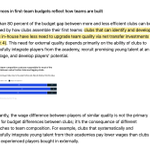
The Zadok Yohanna deal from AIK to Brighton is a clean case study for two recruitment principles: 1. Clubs that make confident decisions from small sample sizes have an edge ~50% of Yohanna's total professional minutes (580') came in the last two months. Most clubs would prefer to wait for the sample to grow before making a move, but by the time it does, the price has already moved to reflect the larger sample size. Brighton (and other clubs, possibly because they trust Brighton's strategy) act earlier because they bet on their ability to analyze sparse information and make projections from a small sample size. The uniqueness of each player makes this principle a case-by-case application, but after watching Yohanna on Wyscout, this is a player where a 30 game sample size would only confirm - not deny - what the first 10 already show. Paying a fee that looks inflated relative to the player's experience and current level is rational when you're confident in a sample (or your analysis of that sample) that everyone else considers too thin. 2. There is lucrative business in being the middleman AIK signed Yohanna out of Nigeria, gave him a platform in European football, and sold the proof of concept at a significant multiple. Scandinavia has become the connective tissue (middleman) between the West African market and bigger European leagues - sourcing the talent and letting buyers pay for the network connection rather than build those relationships themselves. This type of arrangement carries a better risk profile for the buyer and an enormous return for the seller, which is why it keeps repeating. The middleman's real product is their leveraged position within the supply chain that connects two markets who otherwise don't interact with each other. Source where the information is this, decide before the market adjusts, and price on your own conviction.
6
10
3
116
23,902
Jonathan Stoop retweeted
Current events at Man United remind me of a few Jason Wilcox podcast quotes from Nov 2025 that now seems completely incoherent: "Ruben's got a clear idea. It's a lot more flexible than people give it credit for" "We're really clear. Myself, Ruben, Omar, the ownership. Really clear on the direction of travel" "We're very clear on the profiles... the brief will come from myself and Ruben... a lot of debate and discussion" My read: The friction has always been there. A recruitment strategy built on the (supposed) alignment between two people who see the game differently is a fundamental misalignment. JW is skeptical of system-specific team-building. RA is uncompromising. That's the bottleneck. Everything downstream is corrupted. My assumption: JW has always pushed for a more flexible approach. RA perhaps verbally agreed (hence the JW quotes) but never followed through. Finally RA gives in and his pride is damaged (hence the MANAGER not coach quote). It is untenable now.
8
23
3
187
53,425
Jonathan Stoop retweeted
Catching up on MNF's segment on Brian Brobbey and pleased to see so many parallels to what I describe in my article (The Advanced Pivot), specifically in reference to Brobbey. "Once the defender's been pinned, there's nothing he can do, it's game over." This is the seal technique visualized below. Establishing body position in front of the defender kills defensive initiative and gives the striker control of the duel before the ball arrives. Pinned defenders are vulnerable and left with little to no solutions. What Thierry dissects technically is what I framed conceptually as "attacking without space." Brobbey's style inverts conventional attacking logic of playing towards "free" teammates with space/time. Strikers with the ability to seal defenders create multiple attacking affordances with no space/time. Cool to see this working effectively at the highest level. I've followed Brobbey since his Jong Ajax days and appreciated how his unique profile primes teammates to perceive affordances that wouldn't exist otherwise. As I explain in the article, I think this attacking tactic (along with other similar "pivoting" dynamics) will increase in usage and effectiveness against man-oriented defenses that have stifled conventional positional attacking styles that intend to generate space/time for attacking actions.
2
2
16
4,554
Jonathan Stoop retweeted
So much of the problem in football is the inability to reason correctly. Chess, poker, mathematics, finance, economics—any field that demands you to reason super rationally gives you a huge leg-up in football. Football organizations will do well to bring in thinkers from those fields. Look at Pep Guardiola. The reason he is the best manager of all time is his ability to philosophize. Arteta, his greatest protege, is an American CEO type. They ARE RUNNING RINGS around traditional football thinkers.
5
42
4
613
33,041