

Building in DeathTech Data Innovation Lab @nationalgridus "Quit, don't quit. Noodles, don't noodles" • @GEMFellowship & MSCS @Northeastern
Boston, MA, USA
Joined February 2012
- Tweets5.3K
- Following1.9K
- Followers1.1K
- Likes25.7K






Pinned Tweet
The other day, @nikitabier publically stated he’d never build a B2C app for adults. Well, I’m putting it out there—I’m going to prove him wrong.
Who knows, maybe in a couple months, I’ll be lucky enough to ask him for some advice!
Let the games begin, my friend!
Kai Ray retweeted

Introducing @hyperknow_ai: a new way to learn.
The AI professor that turns any learning goal into a 1-on-1, interactive and systematic course.
While all other AIs are rushing to replace your thinking,
we raised $1M to bring back that simple excitement of understanding something for yourself.
Give Hyperknow a topic, a textbook, or anything you’ve struggled to understand before.
Watch it turn your curiosity into a personalized course, with structured units, lessons, practice, and even hands-on projects, then walk you through it on an interactive whiteboard that feels like having your own professor beside you.
More than 100k learners have already explored new worlds with Hyperknow.
Now it's your turn.
Kai Ray retweeted

In 1986 a guy got kicked out of every casino in Vegas for counting cards. So he flew to Hong Kong with $180,000 and started betting on horses instead. He walked away with almost $900 million.
It's Bill Benter. He figured horse racing was just another counting problem. Same math, more moving parts.
He and a partner showed up with $180k and a computer. Benter spent years teaching that computer to guess one thing, the real chance each horse had to win. If his number was better than the odds the bookies gave, he bet. If not, he skipped it.
That's the whole trick. Expected value.
EV = p · b − (1 − p)
Only bet when your win chance p, at odds b, is worth more than your chance of losing.
This recording was never meant to be some hidden gem. Nobody expected Professor Tsitsiklis to hand the whole foundation away in 45 minutes, but that's exactly what happens on the board. Students in that room pay over $80,000 a year to sit through it. It's free right here. It's free right here.
Every quant, every professional bettor, every hedge fund analyst started with this exact hour. Benter just watched it and actually did the homework.
Almost nobody knows this lecture even exists. Watch it before it gets taken down.
The answer is in this video.
Kai Ray retweeted

Third question on AI.
A question that also remains unasked is whether the AI boom can continue without leading to a massive increase in inequality.
A recent paper by Stijn Van Nieuwerburgh runs the numbers on how much revenue the AI industry needs to generate to recover its massive investment (summary and a link to the paper can be found here: brookings.edu/articles/finan…).
Van Nieuwerburgh’s arithmetic should make us more concerned. AI investments will average about 3.6% of GDP annually between 2025 and 2032. Van Nieuwerburgh calculates that, using a 10% rate of return, the industry would need to generate annual revenues of about $3.7 trillion by 2032 to recover these costs (growing from its current levels of about $200 billion or so). That is significantly more than 10% of current US national income, and will likely remain around 10% of national income by 2032, even if GDP growth rose from its current level.
A large fraction of this revenue will go to capital income. That means a massive increase in the share of capital in national income, which has already risen substantially over the last 25 years or so – now standing at an all-time high of about 47% (bls.gov/news.release/pdf/pro…).
Capital income is much more unequally distributed than labor income, so a massive increase in the capital share of national income will translate into a very sizable surge in inequality.
The rise in inequality may not stop with the capital share. My work with Pascual Restrepo documents that (automation-driven) increases in the capital share of national income are typically associated with rising labor income inequality as well (see, for example, economics.mit.edu/sites/defa…). The same may happen in the next several years, boosting inequality further.
What is missing from our current debate is any discussion of a fundamental dilemma these numbers pose: can the AI boom avoid both an economically costly crash and a huge increase in inequality?
If the industry reaches these revenues, inequality surges. If the industry does not become profitable, a crash, with substantial costs in terms of lost output and jobs, becomes likely.
My assessment would be that the industry is unlikely to reach levels of revenue Van Nieuwerburgh calculates. First, diffusion has been and will likely continue to be slow. Second, competition from open-weight models, which are getting better, will limit how much proprietary models can charge. Third, despite important advances, I still believe that AI models will not be able to automate entire occupations anytime soon, thus limiting their value to businesses as cost-saving devices.
Whether this leads to a crash or not is more complicated and will depend on whether various AI companies are bailed out and what kind of support they receive.
Nevertheless, even if revenues fall short of these gargantuan amounts and we avoid a dramatic surge in inequality, I expect that the diffusion of AI will push up inequality between capital and labor and within labor.
If inequality does surge, a further question becomes central: can our democracy survive such astronomical levels of inequality?

Kai Ray retweeted

CPO of Ramp @geoffintech: I see 3 paths for product managers long-term:
1. The technical PM
2. The tastemaker PM
3. The GM
Kai Ray retweeted

como quitar la depresion en un video de 1 minuto:
más eficaz que los libros de autoayuda xitter.gq/RoyalSerf/status/20739…

Kai Ray retweeted

I genuinely don't understand why everyone isn't using this yet
Andrej Karpathy, a co-founder of OpenAI, posted a simple idea that hit 16 million views: stop using AI to write code, use it to build a second brain.
You point Claude Code at a folder, drop in any source, an article, a transcript, a PDF, and Claude reads it, links it, and files it into a living wiki of everything you know. It compounds like interest, the more you feed it, the smarter it gets.
Here's the whole thing:
> Install Obsidian, create a vault, open it in Claude Code
> Paste Karpathy's wiki idea file and tell Claude to build it
> Claude makes three folders: raw for sources, wiki for its pages, a CLAUDE.md that runs it
> Drop any source into raw and say "ingest this"
> Ask questions across everything, forever
Five minutes to set up, and you never start from a blank chat again.
Full step-by-step guide with Claude and Obsidian, link below.
Bookmark this


Kai Ray retweeted

I spent thousands of dollars building this repo… so you don't have to
50+ landing pages, hero sections & interactive prototypes: every single one generated with "Claude Fable 5", with the exact prompt preserved in its folder.
Steal it. Ship it. Contribute. 👇

Kai Ray retweeted

Jenny Wen, head of design for Claude at Anthropic:
"the design process is dead."
what replaces it runs on machine-readable design systems
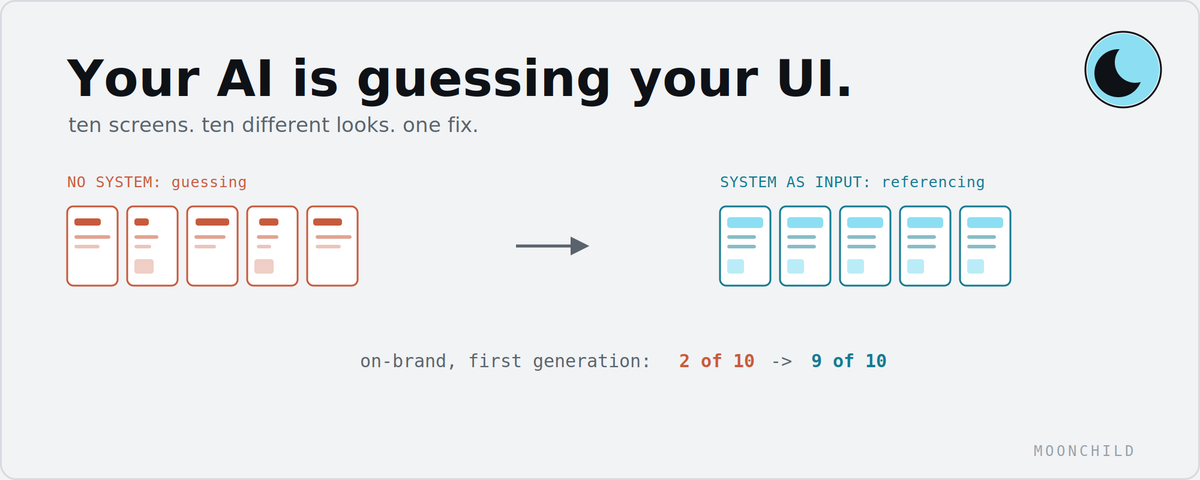
In a 1-hour conversation, Jenny Wen breaks down why the discovery -> mock -> iterate loop is dying and what designers do instead.
design system -> Claude Code -> every screen fixed at once, not one at a time
i rebuilt the same 10-screen dashboard twice:
~6 hours of restyling by hand vs ~40 minutes when the fix lived in the system.
how to build that system and hand it to Claude Code is in the article below.

Kai Ray retweeted

Once you try auto layers there's no going back fr


Kai Ray retweeted

dont be confident, be over confident. be delusionally confident. be so confident that doors open for you and reality bends for you. be sure that GOD walks beside you. The meek inherit nothing if they never believed they were worthy of more. be too much. be impossible to ignore.


Kai Ray retweeted

"I can't believe you guys just did that to me on TV" 😭
Brandon Bussi got emotional after being surprised with footage of his parents watching him play 🥹 (@sportsnet)
Kai Ray retweeted

supervision just hit 40,000 GitHub stars!
it now powers over 6.5k open-source computer vision projects, including all my demos like basketball AI
link: github.com/roboflow/supervis…
Kai Ray retweeted
I can listen to @tylercowen talk all day

Second for second, @tylercowen packs more substance into a talk than anyone I'm aware of. This is a clear, non-hysterical, and somewhat soothing discussion of our AI future.
Kai Ray retweeted

Introducing Honen
The world's fastest way to train skills needed to succeed in the Al era
Simply drop in your org's docs
Get interactive courses that self-improve over time
To prove out our vision, we partnered with NVIDIA to bring AI literacy to 250,000 learners
By 2030, 78M jobs will need reskilling due to Al, and we're ensuring no person or company gets left behind
Learn more honen.com
Kai Ray retweeted

Today, we're introducing Lassie and $47M in funding led by a16z.
We're building AI that runs small businesses, starting with doctors' offices.
Lassie is already trusted by 700+ practices across the country, working autonomously to provide them with 30 hours of labor per month.
To get here, we first had to leave Robinhood and Superhuman to work in offices ourselves.
Here's how that went.

Kai Ray retweeted
Interesting storyline for NHL Finals: Carolina Hurricanes GM Eric Tulsky has a PhD in Chemistry from Berkeley.
Before joining them in 2014, he was offered a job with Apple to work on battery tech (but turned it down).
Started in the analytics department and since hired neuroscientists and mechanical engineers for the NHL team.
The Athletic profile has this anecdote:
➡️ “In 2021, Tulsky was the Carolina Hurricanes assistant GM and had built a small analytics department in the organization, with a web developer, a data engineer and a neuroscientist helping him lead the team’s push into new frontiers for the sport.
But because of what he saw in the tracking data, Tulsky believed his next addition needed to be someone who was working on autonomous vehicles — perhaps “a robot submarine,” he says now — and had an advanced mechanical engineering background.
“I knew that that was the kind of problem that put people thinking about the kinds of data that we had and the kinds of problems we faced,” Tulsky explained.
It goes without saying that there aren’t many robot submarine engineers working in NHL front offices. So Tulsky began a deep search through universities’ mechanical engineering departments.
He would scour the faculty listing and professors’ research interests to see if they might align with what he was looking for, then reach out to learn more about their work. He started with the top schools in Canada, reasoning that there was a greater chance he would find someone interested in working on a hockey problem.
And that was how an NHL team came to fund the PhD research of a young engineering student named Jonathan Arsenault at McGill University in Montreal.
His thesis, the first to be backed by a professional hockey team? “Quantitative Analysis of Hockey Using Spatiotemporal Tracking Data.” ⬅️
***
NYT/The Athletic: nytimes.com/athletic/6286244…


Kai Ray retweeted

Starting a business has never been easier.

AI agents can now start real businesses.
@Meow lets your AI agent form a company, get an EIN, open a bank account, issue cards, and move money in a single prompt.
Works with Claude, Cursor, ChatGPT, Gemini, and more.
The first end-to-end company builder for agents.