
HEC BBA
Montreal
Joined December 2024
- Tweets8.4K
- Following172
- Followers303
- Likes33





Vlad Tchouchkov retweeted

Reminder, because we're now very close to 2027.
By the end of 2027, the world's AI chips could have enough computing power to run 30 - 170 million frontier AI agents simultaneously, working 24/7 and delivering the equivalent working hours of 140 - 720 million full time employees.
With further improvements in AI efficiency, that same hardware could potentially support 1.9 billion agents, producing as many working hours per week as 8 billion humans.
Think about the scale of the productivity explosion we're approaching.


This is the takeoff
Billions of AI workers are coming, and the hardware is already being built.
Epoch AI estimates chips shipped through 2027 could support 30-170 million concurrent frontier AI agents, working nonstop, equivalent to roughly 140-720 million full time workers by hours worked.
With more efficient models, the same hardware could potentially run ~1.9 billion agents, supplying as many weekly work hours as 8 billion people.

Vlad Tchouchkov retweeted

Samsung and Hyundai are about to talk robot memory at the very top.
According to Seoul Economic Daily, Samsung and Hyundai Motor Group are holding their first ever top management exchange on November 9, with about 170 executives meeting at Samsung's training center in Yongin.
Memory supply for Hyundai's Atlas humanoid robot is expected to be one of the big topics on the table.
Hyundai plans to mass produce 30,000 Atlas units a year in the United States starting in 2028.
Counterpoint Research expects humanoid robot DRAM demand to hit 172,000 terabits in 2030, which would be a 20x increase from this year.
I don't think people realize that memory demand is spreading from AI data centers into robots, and Hyundai clearly wants to lock in scarce advanced memory early.
Samsung is also working with $NVDA on Jetson Thor, the robot chip that will serve as the brain of Atlas.


According to Korean media, Samsung and SK Hynix have locked up most of their future supply with long term contracts.
Samsung has signed deals with 10 large customers and is negotiating with 10 more, and its 2027 HBM supply is already sold out.
SK Hynix has deals with 14 customers that cover more than half of its 2027 and 2028 capacity, backed by upfront deposits.
The interesting detail is how they are building.
Both companies are putting up factory shells early but adding cleanrooms in phases, because they are watching how big tech in the United States funds its AI spending.
Memory used to be priced quarter to quarter, and multiyear contracts with deposits make this cycle look very different from the old boom and bust.
$SSNLF $SKHY $MU $SNDK

Vlad Tchouchkov retweeted

1/5 Token economics in the generative AI era operates under a governing physical formula:
Token Throughput = HBM Size x HBM Bandwidth
Batch size is bounded by hot KV cache capacity in HBM, which scales linearly with concurrent requests. Decode speed per user is bounded by HBM streaming bandwidth.
To double generational token throughput from Blackwell to Rubin, HBM Size x Bandwidth must double. Per-GPU HBM capacity compounds at 40%+ annually through 2028. Hardware throughput is tethered to memory roadmaps.

Vlad Tchouchkov retweeted

We've lived for millennia without AI, but now all of a sudden, it's essential?
Even mandatory?
No, we should refuse to be slaves to the tech bros
They need us to accept & integrate it into our lives in order to profit from it
We're being manipulated into being cash cows
Vlad Tchouchkov retweeted

JEFFERIES DESK:
“.. we enter the last 8 weeks of the year with Tech vs. the S&P 500 sitting MSD above the trendline where we’ve held coming out of the ’22 Tech Wreck.”


Vlad Tchouchkov retweeted
$MU $SKHY
The main reason why the memory shortage isn't going away soon isn't just that capacity will be too slow to ramp up to meet AI demand; it's also because using more memory gives more tokens per watt, so token compute efficiency is tied to memory supply.
When a large language model generates text, it produces one token at a time, and each new token requires a full pass through the model. During that pass, the hardware has to read the model’s active weights from memory, along with the KV cache, which is the stored attention state that lets the model “remember” everything earlier in each conversation it’s handling. The calculations performed on each byte are relatively simple, so the processor finishes its math quickly and then spends most of its time waiting for the next batch of data to arrive from memory. That’s why this generation phase, called decode, is usually limited by memory rather than by raw computing power.
This gives us a handy rule of thumb: the maximum speed for a single sequence is roughly the memory bandwidth divided by the number of bytes that must be read for each token. Consider a 70-billion-parameter model stored in FP8, where each parameter takes one byte, so the weights total about 70 GB. On a GPU with high-bandwidth memory (HBM) delivering around 8 terabytes per second, the model can be read through about 110 times per second, which caps generation at roughly 110 tokens per second for one user. Run the same model on LPDDR5X memory at about 0.5 terabytes per second, and the ceiling drops to around 7 tokens per second. The model and the math are the same; the difference comes entirely from how fast the memory can feed the processor.
So does having more memory mean more tokens per watt? Not directly, but capacity helps in several indirect ways, up to a point. The most important is batching. Every conversation being served needs its own KV cache, so the amount of memory determines how many requests can run at once. When more requests share a single pass through the model, the expensive work of reading the weights is spread across many tokens instead of one, and the energy cost per token falls dramatically. Extra capacity also allows longer contexts and lets systems keep previously processed prompts cached, so they don’t have to recompute that work later, which saves energy. Finally, if a model fits on fewer chips, less energy is spent shuttling data between them.
The key takeaway is that memory capacity is valuable because it enables bigger batches and cache reuse, not because memory by itself makes the hardware more efficient. Once a system has enough room to batch effectively and keep useful caches on hand, adding more memory brings diminishing returns.

Vlad Tchouchkov retweeted

Gavin Baker on memory LTAs: “You might blow up your entire business and your franchise by breaking an LTA. And that was never the case before”
Talking about memory makers moving buyers onto long-term agreements (LTAs), he works through the game theory of what happens to a buyer who walks away from one:
“Let’s just think about the game theory of breaking an LTA. So there’s four companies that matter at scale. There’s Amazon with their Trainiums, there’s Google with their TPUs, there’s AMD, and then there’s NVIDIA who’s much bigger than everybody else combined.”
“Let’s just say it’s 2027, it’s very important to realize memory is, the more memory you put with FLOP for a given unit of compute, the more tokens you get out. It’s the single most important thing you could do to increase kind of token output per unit of compute. And then that obviously definitionally actually lowers costs, which is why the demand hasn’t responded at all negatively. There’s been no elasticity just because it’s kind of the only, it’s the axis that is dominating all others. And this is at some level, a giant Game of Thrones or emperors between these companies.”
“And okay, it’s 2027 or '28, you’re vaguely tempted to break one of these LTAs, try and get a lower price. But to a large degree, market shares are, I think for the next several years, are going to be determined by supply chain allocations and what you have pre-purchased. So if you break the LTA and you, and this is assuming we’re not in a severe oversupply situation, the game theory even holds in a severe oversupply situation. If you break your LTA, and then in the next two or three years, for any reason, leverage shifts back to the memory guys, you’re out of business. It’s over.”
“Let’s just say Google breaks an LTA. There’s an oversupply. I’m making this up, in '28, '29. They break their LTAs. Well, if they’re breaking their LTAs, it probably means, your oversupply, prices are coming down, and then, capacity naturally contracts. Well, what do you think is going to happen to Google’s allocations? And then, this is a cyclical industry, and oversupply is followed by undersupply. What do you think they think is going to happen to their allocations next time?”
“So I just think given that this is the axis around which kind of everything is revolving, man, you might blow up your entire business and your franchise by breaking an LTA. And that was never the case before.”

I'd like to believe LTAs are durable too. But take one example.
Analog chipmaker onsemi said this in 2023.
On January 5, 2023, at JPMorgan's CES forum, CEO Hassane El-Khoury was asked how much LTSAs would still hold once the shortage eased. His answer: “They are a legally binding agreement ’cause they’re a liability for the customer because they’re take or pay.” He also said he would not accept a customer reopening price talks just because it could get the same parts 10% cheaper elsewhere.
On October 30, 2023, on the Q3 earnings call, onsemi cut its SiC shipment forecast for the year from $1 billion to more than $800 million after one automotive OEM reduced demand. An analyst asked how this could happen when the company had been saying its LTSAs were legally binding. The same CEO reaffirmed that they were binding, but said he did not want to enforce the contracts just to push inventory onto a customer whose demand had dropped. If it worked for both sides, terms could be adjusted customer by customer, whether by a quarter, a year, or longer.
In its 10-K filings, onsemi also states that it amended LTSAs with some strategic customers by mutual agreement in 2024, and changed delivery schedules and committed volumes on some LTSAs in 2025 as demand shifted.
Microchip is another case. Customers in its Preferred Supply Program (PSP) originally had to place 12 months of orders and could not cancel or reschedule them unless Microchip raised prices. On its November 2025 earnings call, however, the CEO said the company had accepted some cancellations and pushouts so customers could adjust their backlog. On the same call, the CFO separately addressed the multiyear LTSAs the company had signed. Some of those contracts were still in effect, he said, but customers had been allowed to defer taking delivery of committed volumes by one to two years if they needed to.
Every time I see cases like these, I doubt how much memory makers' LTAs will protect earnings in a downcycle. Right now the most reliable thing is the prepayments and deposits themselves. That cash can go into capacity expansion today.
I can picture hyperscalers with no DRAM inventory continuing to buy at current prices. But once inventory has piled up, will they keep taking every committed unit at the same price? I have a hard time picturing memory makers holding customers to the high contract price all the way through.
The LTA itself may never be broken and may stay in place. But if both sides agree to push this year's volumes into next year or two years out, this year's earnings estimates come down. If price gets renegotiated too, margin estimates have to come down as well.
Again, I agree LTAs are sturdier than they used to be. What I question is whether, after demand turns, memory makers can still earn 80% margins on contracts signed during the upturn and keep collecting hundreds of billions of dollars in profit because of those LTAs.
Vlad Tchouchkov retweeted
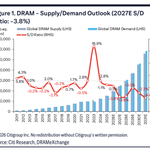
1/5 In July, @zephyr_z9 modeled Big-4 DRAM capacity expanding from 2.0M to 4.8M WPM by 2030. Four months of supply-chain data forces a downward revision to 3.82M WPM (-21%). ASML Low-NA NXE:3800E tool output is capped at ~55/year, with TSMC N2 consuming over 50% of allocation. Memory tool lead times doubled to 24-30 months, imposing an absolute physical ceiling on fab shell tool-in velocity.

Vlad Tchouchkov retweeted

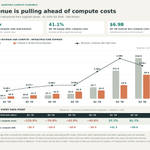
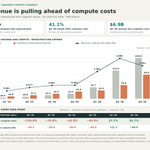
⚠️ RESEARCH: AI spending per worker went from about $520 to $1,024 in one year

Vlad Tchouchkov retweeted

$MU $690.00 +33.61 (+5.12%)
December 9, 2026 is the date $MU can resume substantial share repurchases after restrictions tied to its U.S. CHIPS Act funding expire.
I like the combination of growing profits and reducing the number of shares outstanding.
$MU peaked in June at $1255 and now is almost half off. This is the time to make money. You make your money on the buy price just like a house.
Never own a car.
Live on 50% of your income.
Cook your own food and make coffee.
Then invest in stocks that beat the S and P 500 and never have a boss again. You are the boss and control your destiny.
Control your destiny with $MU. never give up. let's go

Vlad Tchouchkov retweeted

周末老外吵得最凶的话题!
美光远期PE只有3.6倍,沃尔玛却高达45倍,到底谁更值得投资?
多头的逻辑:
如果美光未来两三年真能赚到几千亿美元利润,凭什么还要拿过去的存储周期给它估值?
当年的存储周期,根本没有AI这种结构性需求增量!
现在HBM、DRAM、NAND需求爆发,AI正在重塑整个存储产业的供需关系。
美光已经连续8个季度盈利超预期,瑞银分析师在远期情景推演中,提出过千亿美元级别的回购。
空头的逻辑:
哪怕美光未来赚到五六千亿美元利润,也不能忽视存储行业的周期性。
理由很简单:内存价格迟早会暴跌,毛利也随之崩盘。
过去几十年的存储周期反复证明,即使基本面持续超预期,也改变不了存储行业周期性波动的规律。
现在多空双方,谁也说服不了谁。
个人的看法,股票市场就是情绪、资金偏好,以及华尔街怎么主导叙事。
如果现在花45倍PE去买沃尔玛,还不如学巴菲特先买美债,等市场砸出真正的机会。
Vlad Tchouchkov retweeted

$MU $SNDK $NBIS $IREN
I had the chance to dig into Nomura's memory team note on the midterms.
No federal moratorium.
Any brakes come at the state level, and not one governor-elect in a major data center state has pledged a permanent ban.
2027 is basically locked in.
The capacity coming online next year is already under construction.
What's actually at risk is 2028: about 7% of global new capacity could slip, around 11% in their bear case. Delayed, not cancelled.
Delays also push GPU rental prices higher, and those are already rising… just checkout NBIS spot prices.
Pricier compute pulls forward upgrades to newer GPUs, so a slower buildout can actually be good for chip demand.
Memory isn't walking into a glut either.
Long-term supply agreements let memory makers adjust supply two-plus years out, so the 2028 hit looks milder than the market fears.
Demand doesn't vanish it moves to friendlier states and overseas, runs existing data centers harder, and pays more per GW.
The real risk is a sentiment discount until the Texas session ends in May 2027, mostly for leveraged names with big Texas exposure.
All in all scarce compute just got scarcer.
If you own capacity that's already live, and the chips and memory going into it, you're in a great position to capitalize.
Bullish - Ren ⚡

Vlad Tchouchkov retweeted

🚨 Tons of misinformation are being spread about AI right now
Here are the actual facts
- GPU demand is still sky-high
- token usage is exploding as costs go down
- No, enterprises have NOT hit peak AI
- 99% of workflows still need to be automated
- AI is more correct than almost all humans
- AI helps most humans become 10-100x more creative
- Globally, AI has elevated humans and made the playing field more even
Overall, this leads to a far more efficient, revenue-maximizing system. It will eventually make work optional and usher in the age of abundance
Vlad Tchouchkov retweeted

One thing I find funny about the memory bear case right now.
Everyone seems to assume that CSPs can just walk away from their LTAs, delay data center projects, and leave memory makers stuck with all the new capacity coming online next year.
But if those contracts can really be canceled that easily, what's stopping memory makers from saying, "Fine, then we won't expand capacity either"?
How does the bear case play out then?
It's almost as if the whole narrative assumes memory suppliers have no say in any of this. They just have to sit there and take the hit.

I agree with Damnang on this.
The whole discussion about CSPs canceling their memory LTAs doesn’t seem to start with supply and demand. It starts with the assumption that a lot of these data centers won’t get built, and then works backward to the conclusion that memory will be hit the hardest.
But what has actually changed in the fundamentals? Not much that I can see. What’s changed is the stock prices and the narrative the market is trading. And somehow that’s completely changed how people think about these memory LTAs.
Back in May or June, when everyone was talking about the LTAs memory makers had signed, the discussion was about tens of billions of dollars in customer deposits and how CSPs could lose a huge amount of money if they walked away from those contracts.
Now people talk as if all these agreements can just disappear overnight.
Maybe the better question to ask these CSPs is: do they regret signing those LTAs in the first place?
Vlad Tchouchkov retweeted

Memory Stocks
$MU vs $SNDK vs $SKHY
I mean this is absolutely baffling. I am utterly astonished by these numbers.
These names are mostly debt free in the long term (compared to their cash on hand), trading at non-growth prices with increasing revenue growth YoY (flat in 28 into 29 on $MU and $SNDK).
The peg ratio (which is a metric used to determine the value of a ticker based on their expected earnings growth) shows these companies are being priced at 0 growth. ZERO.
Net margins and operating margins are way on the higher end, above the tech standard.
EVERY SINGLE METRIC SHOWS THEY ARE UNDERVALUED.
I tried my best to find any metric that they could be considered overvalued in but I found nothing.
The only blemish is the 2028-2029 zero growth YoY but even then that is almost 180% more revenue then the FY26.
I dont honestly know what else to say, they are extremely cheap and the market is severely mispricing them.
The only reason I dont own $SKHY is they have different reporting standards as they are an ADR and their financials can be misleading as it is priced in their country's currency, Korean Won.
I am continuing to BTD on memory names. I (along with other dip buyers) will be rewarded in the coming years.
----
Attached:
-Rebased to 100 (past 3m - since $SKHY IPO)
-Financials


Vlad Tchouchkov retweeted
On October 31, Sam Altman reportedly met with around 50 Samsung executives, then had lunch with SK Group chairman Chey Tae-won.
The goal was simple because OpenAI needs more MEMORY.
Samsung has already said its 2027 HBM supply is sold out, and customers keep asking for more.
When the CEO of the biggest AI lab in the world has to fly to Korea personally to secure memory, that tells you exactly where the bottleneck is.
The GPU shortage is turning into a memory shortage, and the companies that make memory now hold the pricing power.

According to Korean media, Samsung and SK Hynix are not seeing canceled memory orders after the United States midterms.
Meritz Securities checked the Americas sales networks of Samsung, SK Hynix, and $MU and said there are no abnormal signs of demand rolling over so 2027 demand is already locked in through long term contracts.
One industry official put it simply. Thirty people are already lined up at a restaurant that is full, and five of them leaving does not create a table.
Modo Energy estimates about 11 gigawatts of planned data centers could be paused, mostly in Texas but if those projects just MOVE to other states or overseas, the net hit to United States capacity by 2030 shrinks to about 3 GW.
Meta and Microsoft are already looking at building outside the United States and the chips still have to ship somewhere.


