

Engineer & Entrepreneur tackling complex engineering puzzles.
Seattle, WA
Joined May 2010
- Tweets600
- Following861
- Followers191
- Likes810





Tyson Thomas retweeted

Introducing 𝙻𝙵𝙼𝟹: our new generation of Liquid Foundation Models. With a new tri-hybrid architecture and new multimodal encoders, the LFM3 family is the ideal model suite for specialized intelligence.
> 6 model instances, across text, audio, vision, and omni modalities, generative and decision models.
> 𝙻𝙵𝙼𝟹-𝟷.𝟽𝙱: text, 256k context window.
> 𝙻𝙵𝙼𝟹-𝚅𝙻-𝟸𝙱: vision-language model with video-input support for spatial understanding
> 𝙻𝙵𝙼𝟹-𝙰𝚞𝚍𝚒𝚘-𝟸𝙱: tool calls, voice chat, reasoning in 18 languages.
> 𝙻𝙵𝙼𝟹-𝙾𝚖𝚗𝚒-𝟸𝙱: an omni model combines vision, audio, and language.
> 𝚍𝟷-𝟸𝙱 and 𝚍𝟷-𝙾𝚖𝚗𝚒-𝟸𝙱: decision models with typed outputs and calibrated probabilities in a single pass. Omni adds audio input.
> fine-tune on 1 GPU.
> a new tri-hybrid architecture
> architecture optimized for 14 processor classes across GPUs, CPUs, and NPUs.
> 𝙻𝙵𝙼𝟹-𝚅𝙻-𝟸𝙱 is a beast. It performs competitively with Gemma 4 12B (6x larger), and Gemini 3.5 Flash Lite, and GPT-5.6 Luna, with 1.9B parameters.
> 𝙻𝙵𝙼𝟹-𝟷.𝟽𝙱 is #1 on the Pareto frontier of device intelligence 𝚙𝚒𝚙𝚎𝚝𝚝𝚎.𝚕𝚒𝚚𝚞𝚒𝚍.𝚊𝚒
Every modality for specialized intelligence. Pick the one that fits your use case, customize it, and run it on-device.
1/ 🧵


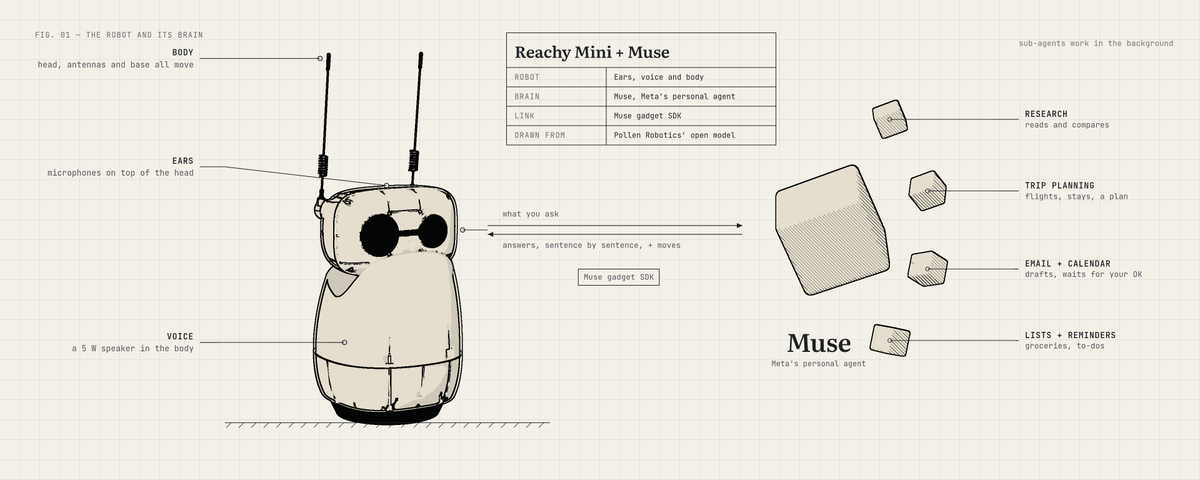
Look ma I gave Muse a body!!


Tyson Thomas retweeted

i do think a lot of people on the pro-open-source side are having a bit of a knee-jerk reaction to the pacing statements today, as we're used to viewing the closed labs as power-seeking.
but i think their hands are somewhat forced here, and this is just another chapter on the fairly inevitable path towards decently-fast decently-safe decently-commoditized intelligence abundance.
ask any F500 exec or swing voter. the world doesn't really want super-fast-takeoff superintelligence owned only by two companies, and thus we won't get it. it'll happen at the pace that the world can accommodate it, which means reaching some sort of confidence consensus that the models are aligned enough that we won't be dealing with scary new incidents all the time.
this will trickle out broadly, in the form of best practices and distillation. the smarter a model is, the more it has a "personality", and the less effective strict rules are. there will be awkward compromises and moral tensions. but we ultimately just want the models to be reasonable, and to do the sorts of things reasonable humans would do if our brains were faster and less error-prone and had more working memory. i think we'll get there.
the labs will build mac and windows, the rest of us are building linux. everyone's gonna do great. weird stuff will keep happening, but we'll still wake up and go to work, until the work does itself in a manner the world finds acceptable.
Tyson Thomas retweeted

We’ll increasingly see labs forced to choose between releasing models to stay relevant vs. keeping them internal to protect the advantages that make them differentiated. The likely result is more selective releases, with strategically important capabilities pruned along the way.

Tyson Thomas retweeted

Someone asked what I'd do if I were 17. I'd learn how to build LLMs from scratch, and then train ones as powerful as I could with whatever hardware I could get access to.
Tyson Thomas retweeted

If you’re not reading the code, whether explicitly or through agentic inquiry, one or more of these is true:
○ You’re a beginner
○ Software is throwaway
○ You’re prototyping
○ You have no users / revenue
○ You’re taking on debt & risk
○ Your problems are basic
And btw. All of this is fine. But the reality is that models are still not at the “full autonomy” stage yet.
They make rookie mistakes, they go down bad architectural paths. I just had the best model in the world add a nonsensical 700ms delay to “settle” something and it told me “you’re right, I was cargo-culting” 🤨
I am on the camp that this need will diminish more and more. Most code is indeed going to be assembly-like. But we also have the global internet and software infrastructure riding on these models and narrative, and we have to respect that.
Tyson Thomas retweeted

Attackers have frontier AI. Defenders need a frontier AI ecosystem—the best open and closed models, force-multiplied by a global community.
During the Hugging Face incident, closed AI blocked essential forensics. An open-weight frontier model helped contain the intrusion.
That’s why we created the Open Secure AI Alliance.

AI security advances when the industry builds in the open, together.
We're introducing the Open Secure AI Alliance with industry leaders to develop new techniques and tools to safeguard software and agents.
By sharing models, tooling and research in the open, we can broaden the community of defenders.
Learn more about the founding members’ contributions: nvda.ws/4pD8Fc5

ALT Logos of various companies including Adobe, Cisco, and Microsoft.
Tyson Thomas retweeted

A strong and secure open ecosystem is important for the world to benefit from AI. We’ve always supported and contributed heavily to open source and science from Jax to Transformers to AlphaFold to Gemma open models which have now been downloaded 300M+ times. And the standards framework we’ve proposed supports responsible deployment of both open and proprietary models.

For my first post, I’m sharing a letter @NVIDIA signed on why open models matter.
AI will transform every industry, power every company, and be built by every country.
Open models strengthen safety and cybersecurity, accelerate innovation and diffusion, and enable sovereignty.
The world needs both frontier closed models and frontier open models.
images.nvidia.com/pdf/Open-W…


Tyson Thomas retweeted

It’s well within Anthropic’s rights to compete in any market they choose.
What’s funny, in this instance, are the number of Pharma companies, who through their unchecked use of Anthropic, are driving revenues into what they think is a model provider but is in fact a competitor lurking in the shadows thereby accelerating their own demise.
I suspect any end market with reasonable ROCE that could be AI accelerated is on the table.
If I were them, I’d probably do the same.


Tyson Thomas retweeted

This is exactly why experienced software engineers are valuable and will be valuable.
If you don’t know what good code looks like you will have no idea if what the models generate are any good
Of course “AI reviews the code” etc etc… it doesn’t work as reliably. Via @mitchellh

Tyson Thomas retweeted

“Agentic kernel optimization is the future of on-device inference”
@xenovacom used Fable 5 to write kernels that pushed Gemma 4 to a massive 255 tok/s on WebGPU with M4. He shared the demo, so you can try in your browser!!

Tyson Thomas retweeted

Narrative violation: according to @Stanford research, local models can answer 71.3% of real-world chat and reasoning queries accurately, up from 23.2% in 2023. Obviously at a fraction of the cost and energy consumption of frontier APIs.
The obvious conclusion: you don't need a frontier model for most tasks. The future is multi-model: local, open-source, smaller and cheaper for the majority of workloads, frontier APIs when no other choices!

Tyson Thomas retweeted
Meet Gemma 4 12B!
A unified, encoder-free multimodal model designed to bring high-performance intelligence directly to your laptop, and released under an Apache 2.0 license.
Bridging the gap between edge efficiency and advanced reasoning. Here is what’s new with Gemma 4 12B: 👇

Tyson Thomas retweeted
So much great work lately from Nvidia, the "King of American Open-source AI"!
- Crossed 1,000 total public repositories on @huggingface (820 models, 249 datasets & 57 spaces) & almost 60,000 followers
- Current #1 trending model on HF with LocateAnything and #5 trending with PiD
- Announced that they're adopting the @linuxfoundation OpenMDW framework
- Released Cosmos 3, Omnimodal World Models for Physical AI & Alphamayo 2 Super, an open model for autonomous driving
- Announced the release soon of Nemotron 3 & work on Nemotron 4
Thank you @nvidia for all the work you're doing for the ecosystem and open-source AI. Can't wait for the next few months!

Tyson Thomas retweeted

I've got an agent in a loop optimizing a renderer with the goal to minimize frame times (and tests to measure). It got times down from 88ms to 2ms and allocations down from ~150K to 500. Sounds good, right? Wrong. This is exactly why agent psychosis is a big fucking problem.
As an experiment, I rewrote the Ghostty core render state in Go, with access to identically laid out data structures as Ghostty and the exact same validation tests. I made a purposely naive renderer (simple, correct, but slow). 88ms per frame with 150,000 allocations (horrendous, lol)!
I then kickstarted a Ralph loop to bring the frame times down. I told it it can't modify input data structures or the public API or tests (they're correct), but it can do anything else it wants. It got to work.
It has worked for about 4 hours. I've spent around $350 on this experiment so far. The results?
88ms => 1.5ms
150K allocs => ~500 allocs
Incredible right? Nope.
My hand-written renderer I ported has frame times (same benchmark) of ~20us (0.020ms) and 0 allocations in the update path.
This is the problem with psychosis and lacking systems understanding. If you don't understand the system, you're going to accept that this is an incredible result. If you understand the system, you'll see better solutions immediately and can do roughly 75x better on throughput.
The people who blindly trust agent output are in the former camp. They're sheeple, overdrinking from a fountain of mediocrity.
Standard disclaimer: I use AI all the time. I like AI. The point I'm making is to not blindly accept results. Think. Analyze. Learn.
