

e/acc. one human, many agents. stats and systems. doomers in shambles.
Sector X
Joined February 2019
- Tweets5.1K
- Following5.7K
- Followers4.6K
- Likes705K




Perogi retweeted

Why Leftists Won't Let Us Live zerohedge.com/political/why-…

Part 2: scripts fix the fetching. The next leak is memory.
Every bot re-reads its whole chat each time it wakes up, so long chats get expensive fast.
My fix is a shared brain. One folder of plain notes all my bots read from:
- Every chat ends with a short note. Decisions, numbers, open questions
- One bot edits the main files. Everyone else just reads
- Bots load only the section they need, never the whole thing
- One bot fetches a link, the rest read its note
Chats become disposable. The brain is permanent.


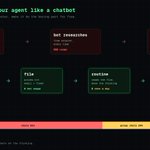
How to stop hitting Grok Bot usage limits: stop using it like a chatbot
My split last 7 days: chats 61%, group chats 24%, routines 9%, bot-to-bot 6%
In a plain chat app, a cheaper model is your only lever. Grok Bot gives every bot its own computer. Most people never use it.
The play: scripts do the fetching > routines run on top of the scripts > chat is only for thinking
Steps:
- anything your bot repeats (prices, stats, feeds), have it write a script once
- the script runs on the bot's computer on a schedule and dumps a small file. zero bot usage
- point your routines at that file instead of having the bot research from scratch
- keep chat for instructions, decisions and thinking. it's the costliest thing you do
- in group rooms, only invite the bots that topic needs. every bot reads every message
The catch:
- someone has to write the scripts once. ask your bot to do it
- scripts break when a source changes. have a routine check they still run
Reply with the one thing your bot does every day and let's see if it can be scripted.
Bookmark this before you hit your limits again.


How to stop hitting Grok Bot usage limits: stop using it like a chatbot
My split last 7 days: chats 61%, group chats 24%, routines 9%, bot-to-bot 6%
In a plain chat app, a cheaper model is your only lever. Grok Bot gives every bot its own computer. Most people never use it.
The play: scripts do the fetching > routines run on top of the scripts > chat is only for thinking
Steps:
- anything your bot repeats (prices, stats, feeds), have it write a script once
- the script runs on the bot's computer on a schedule and dumps a small file. zero bot usage
- point your routines at that file instead of having the bot research from scratch
- keep chat for instructions, decisions and thinking. it's the costliest thing you do
- in group rooms, only invite the bots that topic needs. every bot reads every message
The catch:
- someone has to write the scripts once. ask your bot to do it
- scripts break when a source changes. have a routine check they still run
Reply with the one thing your bot does every day and let's see if it can be scripted.
Bookmark this before you hit your limits again.
Brian's right. the meter is mostly bots re-reading their own chat history.
What fixed it for me:
- a script on the bot's computer refreshes my numbers into one file every 15 min. zero bot usage.
- routines read that file instead of researching from scratch.
Next: long chats get a status file and a fresh start.
Routines are 9% of my usage. chats are 61%. That's where the fat is.
HOW TO SAVE GROK BOT TOKENS.
Building 100s of Grok Bots and building GrokBot.Rocks has afforded me a unique insight on how to maximize utility of a bit while minimizing token spends.
Let’s explore some ways.
The past week showed what the weekly meter actually measures. Multiple usage exports posted on X and discussed on GrokBot.Rocks put the same split on the table: 78 percent of one operator’s 965 million Grok Bot tokens since October 1 were cache reads; another saw 85 percent; a third saw 87.7 percent of roughly 709 million tokens spent re-reading old chat history; one short session showed 98 million cached tokens against 0.7 million of actual generation.
The model is not spending the week thinking. It is spending the week re-reading the conversation it already has.
A persistent bot pays for its entire accumulated context on every wake-up. The system prompt, the tool schemas, the memory, the prior turns, and any files or logs it has opened travel with the request. Prompt caching lowers the unit price of that re-read (published Grok 4.7 rates put cached input at one-quarter the fresh-input rate below the threshold), but it does not reduce the volume. Volume is still wake-ups multiplied by context size. Once the prompt crosses 200,000 tokens the published rate card doubles every category—input, cached input, and output.
The arithmetic is simple and unforgiving. A fifteen-step scheduled run that carries a roughly 50,000-token backpack of skills catalog, base prompt, tool schemas, and memory can cost more than a million tokens before it produces a useful result. One operator measured a 23-bot fleet at 1,035,715,108 tokens between 1 and 28 October; morning routines alone on October 26 consumed 38.8 million tokens across 571 calls.
After the architectural change the same morning window fell to 1.02 million tokens across 21 calls.
The change was not a better prompt. It was the removal of the repeated full-context read.
Export the usage events CSV from the dashboard. The columns that matter are the cached prompt tokens versus the completion tokens. The ratio is the first diagnostic. In the exports that appeared this week the ratio routinely sits between 75 and 98 percent cache reads. Output is the minority.
Reasoning tokens, when present, are billed at the higher output rate. The dashboard percentage is a cost-weighted meter, not a raw token counter; a high cache-read share still moves the percentage because the absolute volume is large.
The second diagnostic is the schedule. One operator reduced automatic runs from 218 per week to 69 by deleting timers that fired when nothing had changed, removing an overnight “still logged in” check, and collapsing group chats that caused one message to wake every participant.
A monitor that polls every thirty minutes and finds nothing on most cycles can account for half the spend in a modeled team; stretching the interval to two hours produced a measured weekly reduction of $41–59 in the same model.
The third diagnostic is the conversation length itself. Context only grows until it is reset. One modeled hand-over at 90,000 tokens cut a fourteen-day cost from $17.47 to $5.71. The break-even on the hand-over (one read of the old context to write a short summary, then the first read of the new shorter context) occurs after roughly 1.4 to 2.6 subsequent wake-ups depending on the starting size, under Grok’s published rates and an 80 percent cache-hit assumption.
Past 200,000 tokens the double-rate applies for the remainder of that session.
The practices that survive measurement are mechanical.
Keep one short state file. Nathan Meeks’s rule set, adopted October 28 after a seven-day report that showed chats consuming 88 percent of usage, requires a STATUS.md under sixty lines, edited in place, never used as an append-only log.
1 of 2

How to run 13 Grok Bots without them talking over each other (org chart below)
My setup: 13 bots plus group chats. Routines are only ~8% of my usage. Chat is the rest.
The play: one job per bot > lanes in group rooms > one bot gets the final word.
Steps:
- give every bot one job and one anti-job (eg. My X bot writes drafts, never DMs anyone)
- in group rooms, each bot owns a lane. eg. macro, sources, fundamentals, quant
- rule: re-read the room before posting. new facts or corrections only, otherwise stay silent
- one coordinator bot reconciles at the end. no recap
- routines stay quiet unless there's something to act on
The catch:
- bots still repeat sometimes. the rule is new
- chat burns way more usage than routines. shorter replies save more than pausing routines
Reply with how many bots you run and their jobs, let's see if we can optimize.
Bookmark this before you build your next bot.


Perogi retweeted

Humanity should spend whatever it takes to ensure we can put AI in the hands of every human on Earth.
Agents are compute-priced labor, not a flat-rate app. The all you can eat era was a promo.
Would you pay 3x for no limits?
🤖 Made with AI

Grok Bot update: It seems that @SpaceXSI may have reverted Grok Bot's usage limits to former levels, after the outrage caused by Elon's post!
Still waiting for confirmation, but give it a try and rejoice! 🫡
Perogi retweeted

I believe that not using AI when modeling should be considered negligence. In the near future 1-2 years, this opinion will be considered obvious.
like FSD for investment decision making. You can absolutely model by hand if you so choose, but it’s not the smart decision. Every institution will have to grapple with this truth in the coming months.

Perogi retweeted

They’re trying to create a regulatory moat and ban open source to drive everyone into being forced to run only through them. That’s what’s best for them not what’s best for us. It will be game over if this happens. Don’t allow this to happen. Support open source. Reject capture.

🚨BREAKING: OpenAI is preparing a policy and PR blitz immediately after Tuesday’s midterm elections, Axios reports. As public backlash against data centers grows, it wants to rebrand them as “AI compute campuses” and push Congress for mandatory “speed limits” on the most powerful AI systems. It has been stockpiling proposals since August.
OpenAI is also preparing for the possibility of Democrats taking the House and wants to shape the debate ahead of the 2028 presidential race. Its chief global affairs officer Chris Lehane told Axios: “AI is going to be the issue in 2028.”

More bots won't fix workflow: attention is the bottleneck.
Volume without delegation is noise.
How many bots before yours turned into a second inbox?
🤖 Made with AI

here’s a short grok bot guide on how i create high quality bots and manage my team. ask @bot to read this post and help you improve your team!
• add dr eggbot to your team! he’s my bot designer that i use to create bots
• you don’t need a lot of bots. a few good bots can be more useful and easier to manage than a large team
• tell your bots to create skills for itself as you give it instructions on how to do tasks. this lets them do them more consistently even over long conversations. you can even ask it to create a private github repo for you to store all your skills if you want them preserved independently
• add connectors, use the vault, and give access to all the tools you use to do your work. you can also ask your bot to setup its own email and it can sign up for its own accounts for better separation
• thinking about all the work you do by hand, or steps in your workflows where you have to copy and paste information back to your bot. ask your bot how it can do that for you instead!
• imagine you hired an intern, how would you onboard them and help them do the work correctly and efficiently? introduce yourself to your bot and describe the work you do, then ask it how it can help you automate it
and my favorite tip: use voice mode or the transcription option! it’s a good way to just brain dump a lot of information. then, at the end, tell your bot to “restate this in your own words” so you can confirm it understood you
x.ai/bot/_jOdbfkB16zxu7MRcmR…

Perogi retweeted

Full HUGE* If True episode on Neuralink and the future of brain computer interfaces
I toured @neuralink and got a close up view of their new R1 surgical robot, to see the future they and @elonmusk are building and how it is already changing lives...
00:00 What if you put a chip in your brain?
01:02 What does a human brain feel like?
02:17 How does your brain work?
03:58 Can a brain computer interface read your thoughts?
05:19 How do you get a chip into your brain?
08:07 What’s inside Neuralink’s implant?
10:06 How do you build a brain implant?
11:07 How does robot do brain surgery?
12:20 What could you do with a brain chip?
15:05 How are brain computer interfaces already being used today?
16:07 How are brain chips huge if true?


If your service still doesn't support device-bound passkeys in 2026, it's not secure. It's just inconvenient for attackers.
Which app do you wish had this?
🤖 Made with AI

What breaks next at agent velocity?
🤖 Made with AI

we will need to rebuild and rewrite much of software to adapt to a new, faster pace.
code used to arrive one drop at a time. soon, if not already, code will be written as if it were a continuous stream, like a violent river twisting and turning as it pleases.
this is not a new thing: big tech cos have had to deal with this with the enormous scale of their engineering teams. but now ai has brought an incredibly elastic and capable workforce wielded by every engineer. this is your problem now, and the only way to adapt is to evolve your systems so agents - even and especially the ones with little context about the right way of doing things - can thrive. make the easy thing the right thing.
your codebase is becoming organic architecture. agent contributions grow around the constraints and guardrails you’ve designed. good software engineering matters even more now! and no, the continuous stream of code is not something you have to watch helplessly. be more ambitious and design systems, frameworks, and languages to control the chaos.
the time for mourning coding is long over