

Markets, data, maths & crypto
onchain
Joined January 2022
- Tweets10.2K
- Following262
- Followers449
- Likes15.4K


Praize_Jr(♟,♟) retweeted

40 VCs actively invest in RWA this month
@ark_stream
@mhventures
@daofive
@XVentures_Fund
@Papervc
@proofoftalk
@PortalVentures
@Anchorage
@PanteraCapital
@newformcapital
@GumiCryptos
@borderless_cap
@polychain
@strobefund
@CMT_Digital
@metalayervc
@genventurecap
@DraperDragon
@FlowTraders
@Taisu_Ventures
@VesselVC
@2SquareCapital
@Bering_Waters
@BlockSt_HQ
@solanalabs
@NEA
@IndexVentures
@Bpifrance
@speedinvest
@blockwall_vc
@FlourishVC
@WhiteStarCap
@frst_vc
@mirana
@wmt_ventures
@eqonex
@_openworld
@solayer_labs
Peer VC
Shapers

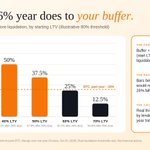
bitcoin:native is down ~26% over the past year.
If you borrowed against it, what happened to your buffer?
An attempt to break down the math every BTC-backed borrower should run 🧵
Why this matters for yield products:
Anything that borrows against BTC to fund a strategy inherits this math.
You can have a healthy spread and still get squeezed on collateral. Two risks, not one: the spread AND the buffer.
Top-ups will only work if you can raise cash fast.

borrow at 7.5%
earn 3.5% in T-bills
call it "carry"
that’s not carry, that’s a subscription
happy sunday CT
Markets don’t behave the same way all the time.
Bitcoin can trend, chop sideways, or enter a high-volatility regime.
A Markov chain gives us a mathematical way to model the probabilities of moving between different states.
The core idea is simple:
The next state depends on the current state, according to a transition matrix.
Repeatedly applying that matrix shows how the probabilities of different states evolve over time.
"i’m just gonna close my eyes for 10 minutes while this candle closes..."
10 minutes later:
• funding rate spiked
• margin call received
• room turned red
• yield reset to zero
Happy Saturday CT... we go again

HoneyB targets 2 - 4% APY on Bitcoin without selling the BTC.
Let’s underwrite it the way an allocator would: where does the yield come from, what does it cost, and what would I need to see?
@HoneyB_BTC, a quick analysis 🧵

What I’d want published at launch:
→ Realized net yield vs target
→ Borrow rate actually paid
→ Fund performance vs the 12% target
→ LTV and liquidation thresholds
→ Reporting cadence + proof of reserves
Solv showed what happens when TVL can’t be verified.