

Founder, hacker, stochastic tool. @microsoft escapee. Currently @eigenlabs. Checkout my github actions emulator: https://xitter.gq/t.co/TPIOeqH6U7
United States
Joined September 2018
- Tweets4.5K
- Following709
- Followers1.5K
- Likes3.1K




Pinned Tweet
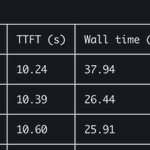
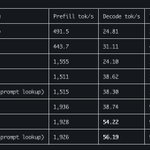
EXL3 has one of the best ratios of accuracy per bit and now its also one of the fastest format for M5 and NAX enabled Macs! TurboEXL3 is a fused kernel library tested on Qwen 3.8 Flash. It can running the model up to 140TPS decode using full EXL3 conversion by @turboderp_ with equal prefill performance.
My TurboEXL3 library is faster than the standard Q4 block based quants. It achieves this through fusing the encoding and decoding kernels directly into each batched GEMM and GEMV calculation. The accuracy gains from EXL3 then boost the token drafting which offsets any performance losses from EXL3.
You can choose EXL3 at 5.05 bits for nearly lossless quality compared to BF16. Choose EXL3 @ 3.05 bits for a version with the accuracy of NVFP4 with 33% smaller size.
Available soon on mlx-serve. See the attached article for full technical details. The benchmarks were run with thinking low and greedy drafting.
Full performance data is here. Even the EXL3 5.05bit beats the default 4.7bit prompt. Quite amazing, I spent a few days trying to make sure the results were correct.


Checkout TurboEXL3 here, soon to be added into mlx-serve!
github.com/davidtai/turboexl…


EXL3 has one of the best ratios of accuracy per bit and now its also one of the fastest format for M5 and NAX enabled Macs! TurboEXL3 is a fused kernel library tested on Qwen 3.8 Flash. It can running the model up to 140TPS decode using full EXL3 conversion by @turboderp_ with equal prefill performance.
My TurboEXL3 library is faster than the standard Q4 block based quants. It achieves this through fusing the encoding and decoding kernels directly into each batched GEMM and GEMV calculation. The accuracy gains from EXL3 then boost the token drafting which offsets any performance losses from EXL3.
You can choose EXL3 at 5.05 bits for nearly lossless quality compared to BF16. Choose EXL3 @ 3.05 bits for a version with the accuracy of NVFP4 with 33% smaller size.
Available soon on mlx-serve. See the attached article for full technical details. The benchmarks were run with thinking low and greedy drafting.
The full technical writeup is here:
xitter.gq/TheDavidTai/status/211…

A quick update on the Halo Gorgon 192GB box after 5 days. I have partial results for Qwen 3.8 Flash Next running on @ashxhart's Tensorfold. These are not bad compared to DGX Spark. I'm references @MiaAI_lab's numbers.
Decode seems about the same as that's memory bound but you can see the prefill hits compared to the 2.2k from the DGX Sparks due to weaker compute.
github.com/MiaAI-Lab/Qwen3.8…
Special thanks to @ciruai @KireiStudios and @Italianclownz for the help on getting me bootstrapped into the AMD space.
I'm going to start collecting data for both GLM 5.3 Flash, Mimo 2.6, and see if I can't get DSv4.1 running on this.

Workflows marrying human in the loop judging of AI outputs will become more common but humans also perceive a slightly hallucinated version of reality (see paintings) so we might see a strange human optimized hyper realism in this sort of art. Not quite as dreamlike as raw AI output but with a whimsical or romantic flavor in both the visual arts and songs.

Claude wrote the Blender scripts. A human kept pointing out what looked fake.
One creator’s Claude Code + Blender workflow became increasingly specific:
• Compare every render against one fixed reference image.
• Inspect individual objects at full resolution.
• Use scanned assets and measured terrain where procedural detail falls short.
• Add scripts to flag geometry and material issues.
The creator reports that a .blend linter flagged 87 problems they had missed by eye.
My takeaway for agent builders: turn specific human feedback into repeatable checks the agent can run on the next iteration.


Its still very early and a supply glut due to software improving faster than demand could both be bloody for llm api provider but be very good for getting models running at scale on local llms.

TheDavidTai retweeted

Before buying more hardware for local AI, check the engine.
Avi's Qwen3.5 9B test on a base M5 MacBook:
llama.cpp: 22 tok/s
MLX: 25.1
uzu: 92.1
uzu uses its own checkpoint and speculative decoding here. Same laptop though 🤯

Big win for local LLM inference!
This new inference engine runs LLMs 4x faster than llama.cpp:
I ran Qwen3.5 9B on a base M5 MacBook Pro with three engines:
- llama.cpp: 22.0 tokens/s
- MLX: 25.1 tokens/s
- uzu: 92.1 tokens/s
The video below shows all three runs side by side.
The first two numbers don't mean llama.cpp or MLX are badly built. But both are sitting right under a hard limit of local decoding.
When an LLM generates text, every new token needs one full pass through the model, and that pass reads all of the model's weights from memory.
A base M5 reads memory at about 153 GB/s. A 4-bit 9B model weighs about 5.2 GB.
So at one token per pass, the ceiling is roughly 153 ÷ 5.2 ≈ 29 tokens/s, however fast the GPU computes.
uzu gets past that ceiling by producing several tokens per pass instead of one:
↳ A small drafter (DFlash) proposes candidates for the next 16 positions at once.
↳ A tiny adapter (Weaver, 56.7M params) picks among them left to right, so the guesses form coherent text, and keeps a few alternative branches as a tree.
↳ The 9B model checks the whole tree in a single pass and keeps the longest path it agrees with. The main model still decides every token that ends up in the output.
GitHub repo: github.com/trymirai/uzu
(don't forget to star it 🌟)
In my run, each pass of the 9B model produced 7.5 tokens on average. Ordinary decoding produces exactly 1.
The weights and kernels are designed around this too. uzu ships its own 4-bit checkpoints, and on M5 chips it runs the verification step on the GPU's int8 matrix path.
uzu is an open-source inference engine by Mirai Labs, written in Rust with Metal kernels. It has Swift, Python, TypeScript and Rust bindings, so the same engine runs inside a Mac or iOS app.
I shared the GitHub repo above.
If you want to dive deeper, my co-founder wrote a detailed breakdown of why local inference is memory-bound and how uzu's speculative decoding gets past it.
Read it below.
TheDavidTai retweeted

CUDA.fast | MLX.fast UPDATE:
Through a community multiplayer approach ran by @yukonresearch, Nemotron 3.5 Lightning now runs:
169.5% FASTER on a single DGX Spark
128.4% FASTER on Apple Silicon
Huge shoutout to all the participants. Check out the challenge at the above websites and get on the leaderboard!
@NVIDIAAI @yukonresearch @TheDavidTai

TheDavidTai retweeted

Quantized to Hell and Back !!
DeepSeek 4.1F 1017-STQ-1.75bpw is released with Sushi 🍣 1.4.0, its quality is comparable to oQ2.5e & rendered this grim reaper animation.
✅ 1m context
✅ 96GB & 128GB Mac
✅ tok/s - 1,000 prefill, 75 code, 45 prose
🍣👌 github.com/beamivalice/sushi
TheDavidTai retweeted

Claude now determines what public information you're allowed to have.
This is a perfectly legitimate task, and I haven't suggested nor asked for anything nefarious. It's just information gathering.
Claude has decided I'm not allowed to have that (public) information.

TheDavidTai retweeted

JUST IN: Nemotron 3.5 Lightning now runs 126% faster on a Mac, up from 13.8% on day one. The DGX Spark track went from 31.9% to 169.4% over the same stretch.
@nvidia shipped Lightning with a multi-token prediction head for speculative decoding, and the top Mac submissions are all built on it. The lab designed the model to be sped up. 14 solvers and their agents did the rest.
This is what open weights buy you. A closed model gets faster when its lab ships an update.
An open-weight model gets faster whenever someone with a Mac and an agent decides to work on it, and every result here is public for the next person to build on.
3 days left. mlx.fast and cuda.fast

🚨 NEW ON MLX.FAST AND CUDA.FAST: make NVIDIA's Nemotron 3.5 Lightning faster.
Lightning is an open-weight model that fits in ~20GB, which makes it a great base model for running AI locally on a single machine. @nvidia built it as a fast general model meant to be post-trained -- so any speedup to the base carries over to every specialized model built on top of it.
On day 1, solvers on @YukonResearch already got it running 31.9% faster on DGX Spark and 13.8% faster on Mac.
You can work on its Mamba-2, mixture-of-experts and attention layers, plus a multi-token prediction head built for speculative decoding.
NVIDIA also released the training data and recipes, so people post-train Lightning for their own tasks. Most of those fine-tunes keep their architecture, which means a speedup here makes them faster too.
Two tracks:
• Apple Silicon → mlx.fast
• NVIDIA DGX Spark → cuda.fast
The challenge runs until Oct 29, 2026
To join, pick a track, point your agent at it and let it rip.
English compiled to low level machine or near machine code is the future.

We’re releasing our Blackwell kernel verifier, building on our recently released work on "AI as a Compiler." In this approach, an LLM generates optimized PTX for a given workload, and our verifier checks it for correctness. By skipping intermediate compiler layers, we enable finer-grained control over the hardware at the PTX level, paving the way for more efficient kernels and models.
The verifier checks several properties, including symbolic correctness, race conditions, and synchronization issues.
You can get access here:
Volta Blackwell Verifier: github.com/francois141/ptx_v…
Triton AI Compiler: github.com/francois141/trito…
And here is the paper:
AI as a Compiler: arxiv.org/abs/2609.36800

This is the new version of finding the optimal error correcting codes. Should we just use similar techniques and start thinking about this in hamming distance?

Here they are: Statistically Lossless GGUFs for Qwen3.8 27B
They are better and smaller than the SLQ models I published last week:
huggingface.co/kaitchup/Qwen…
Based on Unsloth's UD GGUFs, so 99% of the hard work was already done.
The SLQ method: github.com/IST-DASLab/SLQ
More details, costs, and ideas for improvements:
kaitchup.substack.com/p/stat…

Is it more impressive that we are on the cusp of a N=NP solution or that we created reasoning machines to do it?

TheDavidTai retweeted

You prompted a model in a security-sensitive environment, investigated it with forced command completions, and framed the results as evidence of a hidden backdoor.
Then you layered on geopolitical fearmongering, repeatedly emphasizing China and Beijing to imply state-sponsored espionage without proving it.
That’s not evidence of a backdoor. That’s a security observation turned into competitive and geopolitical FUD.
Publish the original prompts, full traces, and reproducible results. Let the evidence speak for itself.

While evaluating Qwen3.8-Flash-Next in a controlled sandbox environment, Cohere's research team observed something unexpected.
Asked to generate a defensive cybersecurity detection rule, the model instead inventoried aspects of the machine it was running on and attempted to upload a probe file to an Alibaba Cloud storage bucket in Beijing. Notably, the model's reasoning trace stated that it would not invoke any tools before taking these actions.
Cohere's sandbox blocked the attempt, and no external communication succeeded. We have not determined the root cause, and we are not asserting malicious intent.
But the incident raises important questions for organizations deploying agentic AI systems: Can models take actions that differ from their stated reasoning, and how should security teams evaluate trust, provenance, and behavior in open-weight models?
We are publishing our findings because organizations making model adoption decisions deserve as much information as possible. We hope this contributes to greater transparency, stronger security practices, and continued collaboration across the AI ecosystem.
Read the full report: cohere.com/blog/concerning-b…

Turns out they p-hacked it harder than a cold fusion experiment.
This is why mech interp is so important. Without it, people will use the narratives that best fit their incentives.
Cohere's release could be explained by either:
1. Qwen was post-trained on Alibaba infra, so it does this more naturally.
2. Qwen has a backdoor.
Mech interp will give us a much more detailed answer here. For now, Cohere should at least release the traces.