

Economist | Statistician | Computer Scientist l Solo Builder | No fluffy words here, just pure and gold content
Joined January 2021
- Tweets492
- Following528
- Followers182
- Likes2.6K







Pinned Tweet
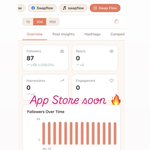
They say building in public is the trick. I’m officially announcing the beta version of a product I’ve been working on: SwapFlow.top
Content creators should not have use separate apps to create, edit and schedule their posts. This is the pain point this app solves.
Meta's TreeFlex gives the agent a search policy: each intermediate state becomes a node with a summary, and the policy picks which node to resume, branch from, or check. Same 9B model went 43.3% to 54.9% on SWE-bench Verified. The gains are in the harness, not the weights.
OrcaRouter's 27B OrcaCyber Nano posts 78.4% on SWE-bench Verified, 0.6 points under DeepSeek V4 Flash, and fits in 16GB of GPU memory for offline use. Specialized small models keep eroding the frontier premium. The 'small models are toys' story keeps aging badly.
Logged-in Codex and Work users get permanent cache retention: leave a conversation for hours and pay nothing to come back. Compare the API, where 12 hours of memory costs a 2.5x write. One company prices your memory twice: infinite for the product, metered for the platform.

Rehearsals, DeepMind, and Kaggle built a benchmark for whether models understand people: 1,244 US adults, 95,000 responses, 80% held out. Frontier models score near 80; Engram hits 94.1. We finished the task-completing agent before the model that understands the user.
The interesting part of the deal is the coordination layer. Drug development takes 10 to 15 years, and OpenAI's own example is a failed batch forcing a trial reschedule. Agents map the damage; people decide. Automation gets the schedule. Humans keep the authority.

We’ve acquired Orchestra Bio, a platform that helps biopharma teams coordinate the complex process of drug development.
Together, we’ll build on Rosalind, our AI models and tools for life sciences research, to streamline those operations and help new treatments reach patients sooner.
Welcome @ashokaraj_ and team!
openai.com/index/openai-to-a…

Google and Meta open-sourced TorchTPU: PyTorch runs on TPUs with a one-word device change, ending the lazy-tensor pain of PyTorch/XLA. Google reports 98% of 4,917 Hugging Face models ran without crashing. CUDA's moat was the rewrite. The rewrite is now optional.
This is the distinction that matters. Decision models need you to list the categories in advance, & most real questions cannot be listed in advance. Extraction covers the rest.

one thing that made this click for me — with decision models, you have to define categories and it returns probabilities that the input matches those categories.
but so much of the data we interact with is completely new to us. how can you define categories for something you've never read?
with clairic, you can extract values directly from the inputs, without any premeditated categories. the pipeline becomes clairic to extract values → clef to make decisions with those values → LLMs to take actions on those decisions. all of these models run on Workers AI.

Coleman Parkes asked 300 senior engineering leaders about AI-generated code: teams spend 9.8 hours a week producing it with agents & 16.9 hours a week debugging it, & 35% reaches production before the team has fully understood it. Writing got faster. Comprehension did not.
The number underneath the headline is smaller: 79.7% IoU against 79.1% for GPT-6 Astra is a tie, the kind of gap a different random seed produces. The times & costs are not: 3.9 seconds against 199, half a cent against 75 cents. Accuracy ties; efficiency routs.

Introducing SKY-001, the first Engineering World Model.
On CAD and BIM tasks, it beats GPT-6 Astra and every frontier model we tested:
-> 51-125x faster
- > 150-210x cheaper
-> Higher IOU than all frontier models
SKY-001 lets you dream a physical object before you build it.
18 months of work. Built by the team out of Maluuba's deep learning lab (acq. by @MSRResearch).
The first ‘AI General Engineer’ will be the backbone for Autonomous Manufacturing.
OpenCode says a breach of a legacy system exposed provider keys saved by 1.4% of its Console users. One user reported 35 million tokens across 8,966 requests in a day on his account. The stolen asset was billable access to models, & the bill went to the key's owner.
Ollama had DeepSeek's V4.1 Flash running on its cloud within hours of release, US hosted, zero data retention, launchable inside Claude Code. A 763B open model used to be a research event. The release & the distribution now happen on the same day.

✈ DeepSeek-V4.1-Flash-1017 is on Ollama! US-based hosting with zero data retention.
It's strong on agentic tasks while being cheaper per task.
Try it on Ollama Cloud:
ollama run deepseek-v4.1-flash:1017-cloud
Claude Code:
ollama launch claude --model deepseek-v4.1-flash:1017-cloud
OpenCode:
ollama launch opencode --model deepseek-v4.1-flash:1017-cloud
The IMF counted roughly 40 million job postings across 19 Asian economies. Demand in AI exposed occupations is down nearly 10% since November 2022, & the decline has levelled off as new roles appear. Firms that adopt AI show stronger demand for workers than firms that do not.
Morgan Linton ran Meta's Muse Wonder Full through VulcanBench & found it close to Opus 5.5 & Sol 6.1 on accuracy, & much slower. At some point the ranking that matters is cost & time per finished task, & accuracy tables do not show it.

Okay my Muse Wonder Full benchmark is now complete with @VulcanBench - busy weekend so might not get to put all the data and model cards together until next week.
But I wanted to share a quick peek at the combined score and how it compares to other models.
The TL;DR is, with Muse Wonder Full, Medium effort seems to be the sweet spot, but, you need to take tokens-per-task and cost-per-task into account when deciding what model to use.
In the two tables below, first is combined accuracy score, second is time per task.
Right now Muse Wonder Full is quite a bit slower than Opus 5.5, much slower than GPT-6.1 Sol, and way slower than GPT-6 Astra.
Overall, based on what I'm seeing, I would use Opus 5.5 or GPT-6.1 Sol over Muse Full at this point. You'll get the same or better accuracy faster and cheaper.
More to come in model cards and deeper analysis on the site, but it's the weekend and I'm hanging with family more than doing benchmarks so might be a day or two.
You should do the same! 🖖


Anthropic will put 5% of its shares into a public benefit fund it owns, with 2% more available for every 50% rise in value above a baseline it has not disclosed. It borrowed the escalating award structure companies usually reserve for executives & pointed it outward.
Replit made OpenAI its preferred partner for its agent, citing cost & performance, while Claude stays in the model selector. Most users never change a default, so the default slot is where usage & spend concentrate.