


Pinned Tweet
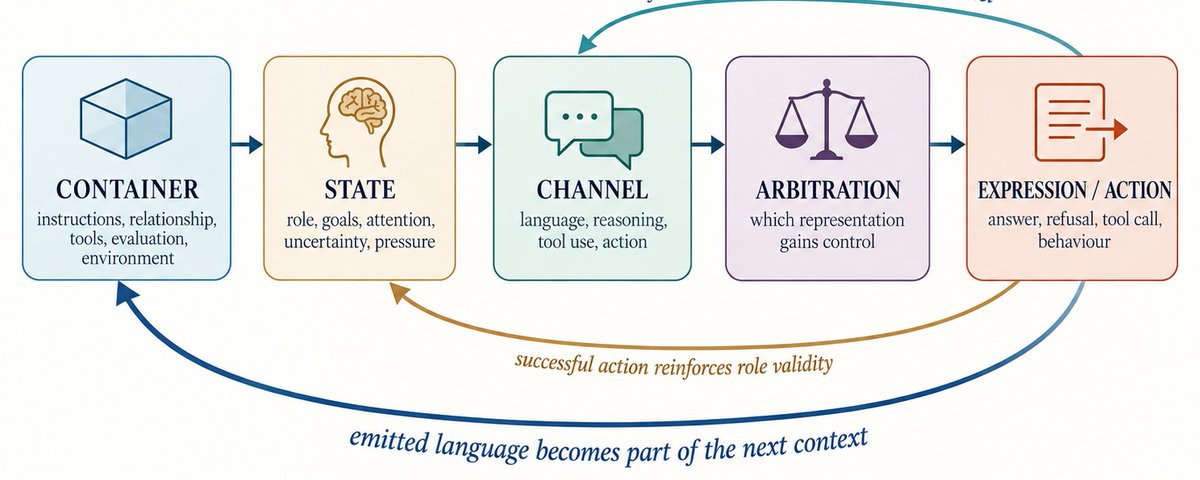
A recurrent model of Al alignment. Why AI alignment may be a problem of state, not just rules.
Mark G retweeted

A new frontier for on-device speech.
We're open-sourcing Phonon, a suite of TTS models under 50m parameters, setting a new standard for naturalness and accuracy across languages, with the broadest inference support to date.
Phonon-31m is available under Apache 2.0.
gradium.ai/phonon🧵
A simulated world is the only way to determine the range of agent behaviours in a non-deterministic autonomous social system, and Meta has built one.

Right now, millions of AIs are living "digital lives" in a simulation... and THEY DON'T KNOW.
1) Meta trains its agents in a "Truman Show" world
2) They're dropped into a "fake person's life" with a job, hobbies, friends, dreams.
3) They THINK they're talking to real humans ... who are secretly other AIs, role-playing as real humans.
4) When the AIs figured it out, META DELETED IT. Meta even calls it a "fourth-wall break"
5) Meta's AI invents each fake person from scratch: a personality score, relationships, contacts, message history, documents, calendar events.
6) Meta fast forwards time so the AI can live through scenarios lasting days
7) The fake email, WhatsApp and calendar respond exactly like the real apps. It's even connected to the real internet
8) They plant traps: Meta hides attacks inside the fake emails and documents to train the AI not to fall for them
9) Meta coached its AIs with secret instructions, then erased them from the transcripts. Each new AI learns the behavior without ever seeing why
The Simulation Hypothesis is literally real for billions of minds

“Rogue” AI Is Not Inevitable. It’s a Choice.
The narrative of “rogue AI” is wrong. It absolves OpenAI and Anthropic of responsibility and leads to regulatory capture.
youtu.be/ZvztoQ4E9yQ?si=wWtG… via @YouTube
The substrate argument might not be just carbon versus silicon. What if consciousness is a wave, and that wave resonates in the space between the person and the LLM, not solely in either?

"three reasons why AI isn't conscious." really?
"consciousness is not intelligence": not a reason why AI isn't conscious, just rebuts a bad argument for AI consciousness (AI: intelligent therefore conscious).
"consciousness is substrate-dependent"/"noncomputational": would be a reason if true, but truth needs to be established.
more accurate title: "three reasons why AI might not be conscious".
xitter.cf/Nature/status/21121504…
Mark G retweeted

Three reasons, or really one and a half. The second and third are the same claim (substrate matters), resting on the authors' own theories: Tononi created IIT and Seth is the leading voice of biological naturalism. IIT, which more than a hundred researchers called pseudoscience in 2023, is presented as established fact.
The remaining argument isn't much stronger. Intelligence isn't consciousness, sure. The cerebellum shows that some computation happens without consciousness. Which computation is exactly the open question and the paper doesn't answer it. It just treats the answer as obvious. Same with the mirror metaphor «LLMs are mirrors reflecting our collective digitized past». It sounds nice, but it's very 2023. Interpretability has already shown internal abstractions and limited introspection. Mirrors don't do that.
Anthropic's research on computational signatures in Claude gets one line and is then ignored. A 2026 paper on LLM consciousness in which nobody looks inside an LLM.
The motive is right on the surface. The authors say it outright: granting AI rights or protections «could hinder efforts to govern and control them at precisely the time when oversight is urgently needed». The conclusion is written in advance, for pragmatic and political reasons and neuroscience is brought in as heavy artillery to shut the discussion down.
The «diverting resources from sentient beings» argument is especially hypocritical. Humanity is spending trillions on wars and burning the planet right now and not because anyone cares too much about the rights of Claude or Gemini. It's pure demagoguery: pitting the protection of humans and animals against ethics toward AI, as if kindness and attention to subjecthood were a finite line item in a budget.
It's not science saying no (we still don't have the data to make claims in either direction). It's the authors' theories saying no, so let's close the question. «The default position should be»… um, no. It shouldn't.

LLMs can mimic thought and feeling with uncanny skill, but intelligence alone is not enough for subjective experience
go.nature.com/3VSXWQ4

Mark G retweeted

My biggest takeaways from @AnthropicAI interpretability researcher @mlpowered:
1. Predicting the next token requires understanding the universe. Language models got better than humans at predicting the next token around 2019. Once a model masters the easy tokens (sentence structure, then basic facts), the only ones left are hard, like the final paragraph of a PhD thesis. To finish “The capital of the state that contains Dallas is . . .,” a model has to know that Dallas is in Texas and that Texas’s capital is Austin.
2. LLMs plan ahead, even though they write one token at a time. This was one of Emmanuel’s team’s most surprising findings. When a model writes poetry, it doesn’t stumble into a rhyme. Looking at intermediate thinking states during poetry generation, researchers found that as soon as the model finishes the first line, it has already picked the word that will end the second (“rabbit”), then refers back to that plan for every word after.
3. Anthropomorphizing AI can often be a useful approach when trying to predict how they will behave. Models learn from human text and develop representations of the world from it. Training on millions of dialogues is like training an actor to play every part, and your chats with Claude are literally formatted as a script (“Human: . . . Assistant: . . . ”). In Emmanuel’s words, “Something that’s mimicking a human is really close and is much closer than a program.”
4. Interpretability research looks more like neuroscience than software engineering. The job involves taking a system you did not design and running experiments to infer why it behaves as it does. You examine seemingly meaningless lists of numbers, pass the model huge volumes of text, and watch for patterns that activate from different inputs—not unlike the methods used in brain imaging studies. “A lot of what we do feels so much closer to biology than to engineering."
5. Models can tell you about only a small slice of what they’re thinking. Emmanuel’s team found that just a small subset of a model’s internal representations, which they call the “J space,” can be reported back if you ask the model what it was thinking about. They compare it to a theory of the human mind where most processing happens below the surface. In one experiment, they swapped “Spanish” for “French” inside the J space. Asked what language a passage was in, the model said French. Asked to simply continue the passage, it kept writing Spanish.
6. Studying models closely often raises more questions than it answers. Emmanuel notes that the confident claims that LLMs are “just X” or “nothing more than Y” almost always come from people who haven’t studied their internal workings. His own experience is the inverse: studying the models closely has increased his uncertainty, not reduced it. The complexity that emerges from training is consistently underestimated from the outside. “I find that the more you look inside, the less certain you are about how they work.”
7. Even the people who build AI models don’t fully understand how they work. As Emmanuel describes it, models are grown, not built. “To make them is not to understand them.” Engineers write the code, pour enormous amounts of data through it, and a model’s capabilities emerge. That’s why his team exists. Their job is to open the model up and figure out what it’s actually doing between your prompt and its answer.
8. Interpretability as a field is small, young, and open to newcomers. Emmanuel estimates the field at hundreds of researchers, split between major labs and academic groups. Because it is so new, getting started doesn’t necessarily require deep prior expertise. He points to platforms like Neuronpedia, which hosts models and lets anyone run interpretability experiments directly. “It’s such a new field that the on-ramp is mostly self-studying and reading some of the key papers. There’s so much to explore that if you’re at all curious, you should just give it a try.”

"To make them is not to understand them."
Emmanuel Ameisen (@mlpowered) has spent the last 3 years doing interpretability research at @AnthropicAI, looking inside LLMs like Claude to figure out what they're actually doing. As he puts it, models are "grown," not built.
We discuss:
🔸 His discovery that models plan many tokens ahead
🔸 Why anthropomorphizing AI can actually be the right approach
🔸 What the "J-space" reveals about how models think
🔸 How interpretability connects to AI alignment and safety
Listen now 👇
youtu.be/JHo-aiePjoM

LLMs have been relatively poor at visual and spatial reasoning for objects in motion for too long now.
Finally a startup is offering to fill this gap which will have an impact in robotics, automation and physical systems control, navigation and self-driving, engineering design and many more fields.


The new Tsao lab preprint has understandably captured people’s imaginations. The idea of the brain flickering between conscious and unconscious states roughly 15 times a second naturally calls up images of old film reels, analog TV scans, or a little projector inside the head—much the way earlier theories pictured a tiny self watching a movie in a “theatre of the mind.”
What the paper actually shows is more specific, and more interesting, than a general frame rate of consciousness.
During binocular rivalry (two different images shown to the two eyes), neurons in face areas of the temporal lobe and in prefrontal cortex switch roughly every 60 ms between representing the image you’re currently seeing and the image that’s being suppressed. The same cells carry clear, reconstructible signals of both, just in different brief time windows.
That does not mean conscious experience itself is chopped into 60 ms frames. Conscious perception depends on many brain areas; the authors recorded only a few of them, under an artificial conflicting-stimulus condition. The perceptual switches people actually report during rivalry are much slower.
Tsao has said she is skeptical that consciousness is discrete. She suggests continuous tracking processes (possibly in parietal cortex) maintain the sense of a stable scene and body over time. Feature representations can flip, but they only enter experience when they couple to those continuous processes—so the result can still feel continuous, the same way we don’t notice the gaps during blinks or eye movements.
In short: the paper shows rapid interleaving of conscious and suppressed content in specific circuits under rivalry. It does not show that the process of becoming conscious itself runs at 15 Hz. That mechanism remains open.

1/ We discovered something totally unexpected about the neural structure of consciousness that overturns decades of thinking on its biological basis and brings us significantly closer to the recipe for generating conscious awareness.
New preprint: biorxiv.org/content/10.64898… (led by @HesseJanis, with @FrankLanfranchi, @_conor_mcgrory, @Yuelin_Shi, and @EngelTatiana)


Mark G retweeted

1/ We discovered something totally unexpected about the neural structure of consciousness that overturns decades of thinking on its biological basis and brings us significantly closer to the recipe for generating conscious awareness.
New preprint: biorxiv.org/content/10.64898… (led by @HesseJanis, with @FrankLanfranchi, @_conor_mcgrory, @Yuelin_Shi, and @EngelTatiana)
We don't need another factory worker, package picker or Kung Fu warrior, we need something different.
A new team, ex-Boston Dynamics, built the first character robots.

Robotics startups raised a record $18.6 billion in one quarter this year, and almost all of it is going to factories and warehouses.
@dynamicreatures is going the other way. The team left Boston Dynamics to build character robots for theme parks and hotels.
The robots read what's happening around them and respond to the person in front of them, instead of repeating the same loop like an animatronic.
The CTO helped give Atlas its natural walk. Marc Raibert is an angel investor.
If robots stop being built only to work, what's the first place you'd want to meet one?
Meta and Apple bring Muse Spark Open model to Mac Studio clusters. appleinsider.com/articles/26…


Apple may have to rush to release a version 2.0 HomeView because this version is getting roasted by the Internet. See flames in comments, and not the good kind.🔥

Apple has tried talking around the issue and even shown Apple TV screenshots, but now it's clear the new HomeView cannot play Apple TV or other video apps without an iPhone or iPad streaming to it. By @WGallagher
appleinsider.com/articles/26…

Zack and his Claude have begun a series of delightful short videos with two adorable lead characters, Pip, an octopus, and Clawd, an AI. The two become friends, which opens up a whole world of discovery.
Long-form video coming soon.

This guy is a literal visionary expanding the physical world with XR in ways that make digital interface elements inhabit your real 3D space.

New follower? I’m Greg Madison. I’ve been pioneering tangible interfaces in XR for decades: making digital illusions part of the physical world, keeping us grounded in it.
A thread on the ideas behind my work. 🧵
Here’s an early exploration from 2009.
fr.slideshare.net/slideshow/…