

onchain technical product human @LlamaRisk. ex - @ArcadiaFi, ml, pg.
Europe
Joined March 2025
- Tweets248
- Following460
- Followers226
- Likes335






Come and join our team!

LlamaRisk is hiring for the following roles:
→ Backend Engineer (Data)
→ Lead Risk Analyst
Come join a fast-growing team of researchers and engineers working to unlock the world's capital.
Roles are fully remote, apply here → llamarisk.com/careers

Quite exciting launch, moving fintech rails to crypto, and making the consumer app is very hard feat. Congrats to @aave team.

2
114
zekiblue.eth retweeted

LlamaGuard Caps are coming soon to @Aave, bringing dynamic borrow caps to V3
Today, each Aave V3 borrow cap is set well above current debt to allow for growth, and that extra room is always open to borrow. Once live, Aave V3 borrow caps will be recomputed from live debt plus a reserve-sized buffer, bounding how quickly debt can grow between updates.
Two agents will manage each cap:
• Raise agent: adds room as organic demand uses it, computed on @Chainlink CRE and validated onchain before the cap is written
• Cut agent: takes room back after large repayments and liquidations, computed onchain from live Aave state
Risk Stewards and governance will remain in control of each cap's hard maximum.
What does this mean for Aave users?
Any borrow up to the size of the buffer clears instantly; larger borrows will need to be split or, for approved large borrowers, executed atomically through the Risk Stewards.
The proposal has passed Snapshot and is moving to AIP. Additional details: governance.aave.com/t/arfc-d…

zekiblue.eth retweeted

Today I’ll be talking about Aave’s response to the Binance hack and what this means for onchain risk management

A fake job interview, a tainted dev install and an internal AI tool: that's how North Korea got $6.34B out of Binance.
@kain and @tayvano_ dig in with LlamaRisk CEO @wormholeoracle .
Live today at 4pm ET here on X
Sorry but this is lame, I was part of hooks incubation and even got an award during that cohort. I’ve believed v4 was novice and net positive for the ecosystem. But this is just doing the thing that you criticize in a very basic way. I hope to see uniswap do better

Uniswap v4 is now an aggregator
Aggregator Hooks wrap external liquidity sources and turn them into Uniswap pools
Live today on Ethereum, Base, and Robinhood Chain in the Uniswap Web App and API
1
32
The EU Inc. may have been the best thing that happened in European business. Let's not go waste. Let European teams compete

Europe’s founders need a European standard to compete globally from day one.
Europe’s leaders committed to delivering one. But their teams are negotiating away the very things that make it one.
There is still time to change course if Europe's Heads of State step in now.


1
33
If you fiddle enough, you can turn a sports car into a dirt bike.

This weekend I invented something new, a new type of token using Uniswap v4 hooks that I call a Pair Token.
A Pair Token is a new type of ERC-20. It is a fused, auto-compounding asset, a fusion of two tokens.
For example, the stock tokens NVDA and SPCX fused into a single tokenized version of the two, with the ticker NVDASPCX, or ETH with NVDA, creating ETHNVDA.
Each Pair Token represents a full-range Uniswap v4 liquidity pool.
So why mint these tokens?
These tokens are self-multiplying in terms of value, as at any moment anyone can call the compound function to compound the LP fees generated by the pair’s trading activity back into the asset.
The token represents a new financial primitive, as it represents a proportional value and moves as an LP position NFT would, except that it is auto-compounding and, thanks to its v4 hook, allows for compounding and self-growth.
Since it is an ERC-20, this token can be freely traded onchain, LPed, or even paired with a launchpad.
A new type of token for a new type of exposure and strategy.
Starting tonight, you’ll be able to mint or redeem Pair Tokens for any pair on Robinhood Chain via the StonkBrokers website.
Minting and redeeming are free, and the compounding process on the tokens incurs a 10% fee on the LP fees generated, which is used for $STONKBROKER buybacks.
I look forward to a new line of products and protocols on Robinhood Chain using this new financial primitive.
Only on Robinhood Chain, powered by Uniswap. @Hookrfun
25

This. Having custom setup while models are improving at rapid pace is dead time. Just have your core setup and leave the other parts to model. Proper research tooling, cross model checks, verify, red teams when you have these the rest falls into place in almost a day of work.

a weird inversion with LLMs is the models improve faster than the tinkerers
when i see people with custom workflows and setups they're all addressing problems that don't exist anymore
the person naively using vanilla codex is more likely to be experiencing state of the art
22
👀
Second one

A proposal to register LlamaRisk’s PT Risk Oracle agents for PT-sUSDe-22OCT2026 on @Aave V3 @Plasma is live for voting.
Over $45M of this PT is supplied on Aave. If approved, our risk agents will dynamically update the discount rate and E-Mode settings as market conditions on @Pendle change and maturity approaches.
Each update will have the following limits:
✅ Discount rate: up to 100 bps (at least 2 days apart)
✅ eMode categories 25 and 26: up to 50 bps per parameter (at least 3 days apart)
Vote here: app.aave.com/governance/v3/p…

1
37

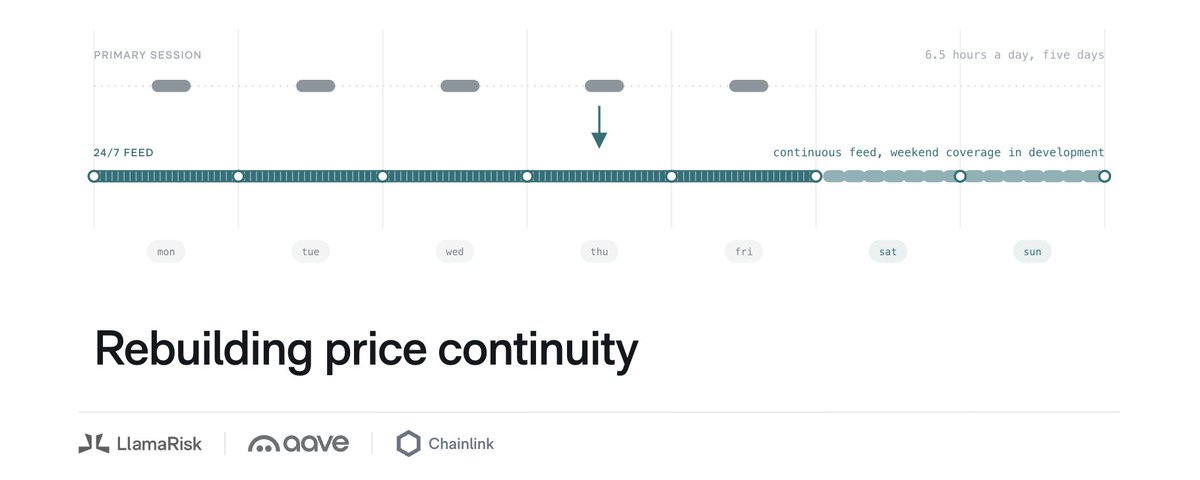
First weekend run smoothly. New asset types onchain needs more attention, we monitored throughout the weekend for this reason. Next goal is bringing continuous price and support to defi.

39
We are live!
The first protocol-owned risk oracle is live on @aave.
Built by LlamaRisk.
Powered by the @chainlink Runtime Environment (CRE).
Owned by Aave.
It dynamically manages Pendle PT collateral risk. First on Aave v3 Ethereum. Coming soon to all Aave PT markets.
Let's gho 👻
Day is closer than ever
the first of many LlamaGuard
Risk parameters that follow the asset.
LlamaGuard PT goes live on @aave v3 Ethereum tomorrow, Sep 2.
"Far and away the best prize that life has to offer is the chance to work hard at work worth doing."
It was a challenge you would want to have, and I'm very proud of my team's effort on this huge milestone.
More to come; follow along @LlamaRisk
The AIP to activate LlamaGuard PT is live for voting on @aave governance.
What a yes vote brings:
→ PT collateral parameters recomputed continuously, every move bounded by on-chain limits
→ Designed for predictable, gradual re-rates. No cliffs
→ A liquidation threshold that rises as the asset de-risks toward maturity
→ A workflow Aave owns, can verify, and can revoke at any time
This is the vote that turns risk management into protocol infrastructure.
Read and vote: app.aave.com/governance/v3/p…

1
28
Pricing PT is not easy. Linear discount > TWAP and automated adjustment to handle the complexity is the way to go. Llamaguard PT is doing that, so Aave PT users are safer than ever.
This morning a Pendle PT lending market was manipulated. A push of less than 3% in the pool price liquidated twelve borrowers holding roughly $36M in positions.
LlamaGuard PT, which we're bringing to Aave, prevents this attack vector.
Borrowers in the PT-reUSD lost about $1.35M between them. Every one of those positions was healthy minutes before. The tightest buffer was half a percent, the widest about two. The design accepts a tradeoff, lenders are insulated while borrowers bear the risk.
The affected markets price PT collateral from a short TWAP of the Pendle pool, taking the lower of that TWAP and a fixed linear discount. But it also connects borrower health factors directly to pool conditions. Whoever can move the pool for a single TWAP window moves the oracle, and in a PT looping market the whole book stacks near the LTV ceiling by design. That's why a sub-3% move made essentially every leveraged position liquidatable at the same moment. It's a defensive market, and the defense is paid for in user experience: holding a position safely means keeping a wide buffer and watching the pool around the clock.
The Aave market, powered by LlamaGuard, is defensive. The quoted price is deliberately conservative. The difference is in how the oracle is allowed to move. It never quotes the pool directly. It quotes a linear discount that re-rates toward a smoothed, multi-day average of the market rate, and only when the drift crosses a published 0.30% gate, no more often than a minimum delay allows, in steps bounded by limits that live in contracts Aave Governance owns. A borrower's health factor moves gradually and predictably.
Run today's attack against LlamaGuard's design. A fifteen-minute pool push barely dents a multi-day smoothed rate. Even a sustained displacement buys the attacker one bounded step per delay window, each with limited price impact. Walking the oracle down far enough to force a cascade means holding the Pendle pool displaced for days, in public, while every step prints on-chain and the risk stewards and guardian watch it happen. The attack doesn't become impossible. It becomes slow, expensive, and visible, with the payoff throttled to a trickle. Manipulation is an economics game, and the economics invert.
A second layer compounds this. On the Aave market the liquidation threshold is dynamic: it rises toward its cap as the PT approaches maturity while the liquidation penalty falls toward its floor. Open a position near the line and, all else equal, your health tends to improve with time, both because the PT pulls to par and because the threshold walks up beneath you. Under a static configuration, a tight position only ever decays.
Put together: the protocol is protected by the dynamic liquidation threshold, borrowers are protected by capped and predictable oracle steps, and the market's stability doesn't hang on a pool that can turn illiquid or volatile without warning.
That's what a risk layer is for. The full argument, and the architecture behind it, is in the piece below. 👇
1
1
35
