

cloud agent platform @mercury
Boulder, CO
Joined February 2015
- Tweets6.4K
- Following712
- Followers606
- Likes43K




Thomas D retweeted

A Staff engineer who joined @AnthropicAI in 2024 is looking at a ~$100M windfall at the $83 IPO price
At least half of that is vested now. Under the lockup's early release terms, employees can sell 10% on day one, so $5M+ in cash right out the gate
We priced every Anthropic engineer offer at the funding round it was signed in, then valued it at $83
- Early 2025, $5.61 a share, 14.8x
- Mid 2026, $58.90 a share, 1.4x
2024 hires did even better because they got options, not RSUs
An offer values an option at only the gap between the share price and its ~$1.30 strike. So the same dollar grant buys way more options than shares, and at $83 each one is worth ~$81.70 (subtracting strike). That's ~48x
Timing beat level too. A Senior who joined in early 2025 is at ~$14.8M. A Lead who joined in mid 2026 is at ~$3.2M
Some of these cells are modeled estimates where offers are thin. Strong data for Lead SWE though.

Thomas D retweeted

what i’ve come to understand and hold true in my head but am always revisiting…
1. we don’t have enough raw resources (memory, cpu, power, data centers) - this won’t go away for perhaps up to 6 to 10 years
2. There is minimal to no moat for the prop labs; except selling poison and cure. They will make money selling expensive expensive cyber tokens in response to the security problems created by AI
3. AI fundamentally has changed work and there’s no going back. The box is open and businesses need fewer humans to run a businesses.
4. AI is an economic munition. If a country depends upon AI (and they will) and their access is suspended then a country will be economically crippled by such sanctions.
5. Openweight models are typically three months behind prop labs. They are a critical counter to $ant.
6. Countries must develop their own sovereign open weight models which codify their culture/customs to protect/encode their nations value structures to protect against cultural homogenization.
7. Distillation is competition and fair game. How it is done is should be the focus of conversation (not “if” it’s allowed) - ie distillation currently happens through theft/credit card fraud - that isn’t good!
Though tough thoughts am pondering about:
8. Training on pre-existing IP is perhaps not theft of IP. The same way that a human reading a book, seeing an idea, learning concepts and then remixing that concept isn’t a copyright violation. Mathematics isn’t IP/copyright theft.

Thomas D retweeted

Thousands of tool definitions in the context window?
@mitsuhiko of @earendilworks makes the case for giving agents JavaScript to run, so they can compose tool calls into a workflow.
From AI Engineer Code Summit.
Thomas D retweeted

And now, a year later, every major harness has implemented it... and they all kept the name.

It's great to see everyone adopting Code Mode! Like most good things @Cloudflare, it started with a blog post by @KentonVarda. He wrote it before the code, and we never got around to figuring out a better name.

Thomas D retweeted

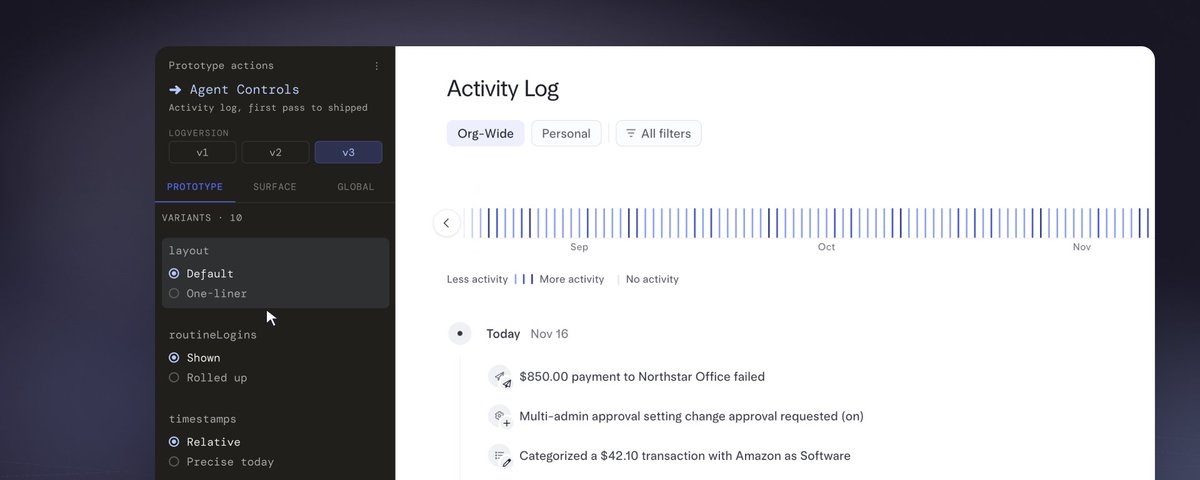
We've been having a lot of fun building our own prototyping tools @mercury that help us ship fast without compromising quality.
Thomas D retweeted

How we built an internal tool (BuilderMode) to make it easy for anyone at Mercury to prototype, while keeping our high design quality.
We are getting this system closer and closer to production to make it easy to go from prototype -> production.

We've been having a lot of fun building our own prototyping tools @mercury that help us ship fast without compromising quality.
Thomas D retweeted

I'm really struggling with this. Not saying that he is wrong on everything, but listening to the scenarios feels like playing a game with a child, the rules of which he is inventing as we go, to end up with a pre-determined outcome.
-- Why would AIs take over the labs?
-- They would want to control everything to cheat on graders
-- How would the AIs take over wider control?
-- They wouldn't want anyone finding out that they cheated so they would start hacking governments and taking control over resources
-- What if government will show up with guns to stop it?
-- They would control the public opinion against that
-- How would they control public opinion?
-- They would hack into all devices and control information flow
-- What if we manage to stop the big data centres anyway?
-- The models will get small enough and will be spread everywhere to control everything
Again, I don't want to say that we don't need to take this seriously - his main point of improving security seems unambiguously like a good thing.
But the idea that we are on a realistic path towards AI's taking over the world in a year just seems like a fantastical idea that is derived by starting from that as an outcome and then backing into it with ever more esoteric unlikely scenarios that must all happen together for this to occur.

.@paulfchristiano thinks that on the current trajectory (absent any slowing down), there is a 1 in 3 chance that we could have superintelligence powerful enough to overthrow the government within a year. (He articulates a concrete scenario).
He argues that the labs should pause further algorithmic progress until they can secure their weights and research secrets. Otherwise China could simply steal the superintelligence in the middle of the intelligence explosion, and the labs would no longer be able to slow down even if they saw their models going off the rails.
He also explains how AIs will be trained during the intelligence explosion, and why even a system trained entirely inside a data center could still have the capabilities profile such that humans would have very little chance of competing with it or controlling it.
And he discusses the plan for alignment - basically, making a superintelligence that actually does what we ask the way we mean it. Fixing reward hacks and building better graders will help up till the next few model generations, but he thinks that no single current approach has better than even odds of letting us control superintelligence. The hope is that the AIs figure out the solution to this problem during the intelligence explosion.
Paul is head of the Alignment Research Center. Previously, he was head of AI safety at the US AI Safety Institute. Before that, he led alignment at OpenAI, where he invented RLHF. He’s recently joined OpenAI’s board (though here he is speaking as a private citizen).
Thomas D retweeted

Over the past week, I’ve been overwhelmed by the love and support of friends, industry colleagues, and people I've never met. Thank you to everyone who has shown kindness to my family and me. It means the world to me.
I came to the United States 53 years ago, and becoming an American citizen is one of the greatest gifts and proudest moments of my life. NVIDIA has been my life’s work. Building it into the company it is today alongside my colleagues has been a privilege and an honor. Nowhere but in America could a company like NVIDIA be possible. I love our country, and I love NVIDIA.
I did not live up to the standards expected of everyone at NVIDIA, and I have made serious mistakes in my personal life. I created problems for the Board that I deeply regret. I own my mistakes completely, and I am committed to cooperating with the Board’s independent investigation.
Since my departure, I’ve seen an outpouring of calls from NVIDIA’s employees, investors, business partners, and customers for me to return as CEO. Many continue to reach out to me directly as the company navigates complex technology, market, competitive, and geopolitical dynamics. NVIDIA is a once-in-a-generation company. If the Board of Directors decides that my return is in the best interest of our shareholders, our employees, the company, and America, I would be honored to answer these calls and return as CEO.
Thank you again to everyone who has shared their good wishes. I am profoundly humbled by your support. To my family: I love you, and I will spend the rest of my life being worthy of yours.
Jensen
Thomas D retweeted

I’ve read this a couple times now, and while there is, frankly, a lot of sloppy argumentation (which I will get to), the charitable, simplified read of Dwarkesh's position seems to be:
1) AI needs major breakthroughs to achieve AGI/ASI (continual learning, sample efficiency, etc.) — this is a view he’s held for some time now, in line with Ilya
2) These breakthroughs, and the ML research skills required to obtain them are verifiable, and thus current, pre-breakthrough AIs can hill-climb on these sorts of problems and capabilities to solve them (like we saw in math)
3) Once these breakthroughs occur, we *may* see rapid, recursively compounding gains to intelligence, leading to ASI in a very short period of time
There's a ton of other stuff in the essay, but I think this is the basic crux. Christiano basically articulated this same argument in his Dwarkesh appearance, and if you look at AI-2027, it essentially follows the same trajectory: Agent 2/3 makes a ton of algorithmic progress, allowing Agent 4/5 to explode.
In general, I think the high-level narrative here is...fine? It’s certainly one plausible outcome. But, imo, it is a much narrower path than I think many are giving it credit for—a lot of things actually have to go just right for this to play out. And here's where I return to the other, messier arguments, because many of the intuitions and arguments driving Dwarkesh's view in favor of near-term ASI (e.g., EO2027) as a highly probability outcome (~50%) are, imo, quite bad:
- “[We'd see] a jump as big as GPT-3.5 to GPT-6 Astra in just 12 months” -> No, under this scenario we’ll see ~4 years of AI progress in 1 year. If there are diminishing returns, then this won’t be as extreme as the jump we saw from GPT-3 to GPT-6. It very well could be, but that would require innovation to overcome the diminishing returns we'd expect in the base case.
- “The other big piece of evidence for transfer is human evolution” -> Except if AI was following the sort of pattern we saw for human evolution, we should have seen better transfer long before AI started solving millennium problems. This spikiness has been one of the big surprises of AI!
- “Rather, my claim is that scaling up RL training will give AIs the abilities necessary to ramp quickly in new contexts…it’ll go through an evolutionary process that involves centuries of corporate competition to figure out the optimal organizational techniques.” -> These are in direct conflict! If ramping requires RL runs that simulate centuries of competition within “digital economy full of millions of other AIs” then that’s quite bearish for ramp speed (relatively) given the compute and wall-clock requirements!
- “I have a lot of 20-something-year-old friends whom I’ve watched accomplish incredible things and build world-leading companies and ventures in domains they entered into with no previous experience.” -> lol. rip leopold. But also, again, these are humans, with human sample efficiency. If AI gets there, sure. But how soon it gets there is the big crux.
- “Obviously, some pieces of feedback—about how your actions impacted the quarterly earnings, say—require months of serial time. But even granting that, we should expect these future AIs to be able to get to top human performance in almost all domains within months of being deployed.” -> …no that’s not how that works at all because one set of earnings isn't enough to robustly learn from and you can’t re-run the same real-world conditions.
- “[Sample efficiency & online learning are] AI’s equivalent of a Millennium Prize problem. And mathematics has already shown us what happens to such problems” -> Sure, but there’s a difference between “AI can solve a Millennium-level problem” and “AI can solve *this specific Millennium-level problem*” -- if the blocker is a specific problem, the timing spread becomes much wider.
- “My answer to this [experiment/wall clock/compute] objection is that each agent will still have access to a ton of compute. Frontier labs have been more than quadrupling their compute every single year.” -> But that’s what they’ve needed to do keep up with their current pace! Even if the labs maintain their current pace of compute growth (and like, will they even? capital markets really do not seem accommodating and Dwarkesh's roommate just lowered his compute projections), we'd still need a step change in pace above that!
And that's not even covering the biggest crux of all: whether the returns to intelligence continue to recursively compound faster than diminishing returns eat into them.
Now, are any of these objections fatal? No. Do they “disprove” hard RSI/an intelligence explosion? No, ofc not. Am I kind of nitpicking here? Yeah, 100%.
And to Dwarkesh's credit, he does anticipate and acknowledge a scenario (the “spark”) where these objections play out.
But the reason I've bothered to rant this long is that I see a lot of AI/RSI discourse follow this pattern: where 50% of the arguments are reasonable and grounded and appropriately hedged, and then the other 50% are these sorts of sloppy intuition pumps and what-ifs that include a ton of detail but a noticeable lack of rigor. And I can’t help but get the sense that it is the latter 50% that is really driving people’s predictions and expectations here, as it leads to sentences like this:
“In the spark scenario…it takes years to get to the same endpoint that the software-only singularity would have achieved in months: a superintelligence that is to us what we are to chimps.”
Note that Dwarkesh thinks these two outcomes (spark vs. software-only singularity) are equally likely. 50/50. I’m sorry, but that’s absolutely nuts. Even Christiano put the likelihood of ASI by in 2027 *absent any slowing down* at only 1 in 3, and I still think that's too bullish.
Like, yes, I fully anticipate that we will have automated AI researchers (or something close to them) in 2027, and the universe where we go from that to a software-only singularity is not entirely out of the question. But obtaining that universe relies on a confluence of various frictions, diminishing returns, and wall-clocks being overcome, a somewhat specific set of algorithmic innovations being made or obviated, and an assortment of other factors playing out just-so to enable that perfect storm. Even a fairly rapid exponential doesn't qualify when you're talking about full-blown ASI in 13 months. It may not be impossible, but it's certainly not a 50/50 outcome.
Thomas D retweeted

My Empire of Dirt geohot.github.io//blog/jekyl…
Thomas D retweeted

A thousand years ago, I made a dent in dev envs with “Vagrant.” The most popular request always was “I want Vagrant for remote envs.” I’ve been asked this to this day!! I tried and failed many times. I made things that worked but didn’t work right. Well, Rex is done right. Rex is my answer, finally.
It’s always lived in the back of my mind no matter what I did. I would come up with something and try it and it didn’t feel right.
I got really close around 5 years ago to the point I setup a website branding etc (via HashiCorp). But at the last minute I pulled it. It still wasn’t right. I couldn’t explain why and didn’t have a better solution. I just knew it had to be binned.
Well, Rex is it. This is the real deal.
Rex is doing for remote development (and a lot more than just dev) what I think a proper solution should’ve done. It’s far more than just a dev tool but I think part of what I knew is once you reach into remote environments that line isn’t clear anymore. You have to solve both remote dev and remote prod.
Here we go, back to the beginning.

Thomas D retweeted

A brief history of AI Coding since Nov 2025:
Nov 2025: Opus 4.5 releases, OpenClaw gets built
Dec 2025: community agrees that models get good enough to handle 95% of coding tasks
Jan 2026: Ralph loops get popular, early efforts on loops/orchestration
Feb: Everyone feels knackered, too much strategic decision-making, fears around cognitive debt begin
Mar: Skills explosion as community converges around easy-to-share processes (superpowers already ahead of the game here)
Apr: most SOTA devs haven't written a line of code in months
May: "The unreasonable effectiveness of HTML" - more interest in richer review surfaces
Jun: "Loop Engineering" wins vaguepost of the year, signals more hype around process
Jul: Every talk in every conference becomes "here is my software factory"
Aug: Opus 5 speaks incomprehensibly, interest in ASD-STE100 peaks
Sep: Grok Bot gets popular, more interest in long-running "manager" threads which retain context and delegate work
Oct: The promised speed gains haven't materialised, "dark factory" feels a long way off still
Nov: No-slop manifesto releases, reading the code still appears essential
TL;DR: no-one is writing code anymore, and we are still figuring out what that means
Thomas D retweeted

we don't have to live this way. senior engineers have the duty of building guardrails and teaching the next generation of programmers the practices that lead to high quality software.
AIs may write most of the code, but you still decide what ships. we should never lose our taste for quality software.
i made this analogy a while back: everyone can cook at home but yet restaurants still exist. the floor is rising, but so is the ceiling. the best software will always be made by those who care.

Thomas D retweeted

You work your ass off solving really hard problems day after day for decades, and this is what you get: anyone could have done it.
As an investor, I can tell you the limiting factor isn't investment. It's founder ability.

Thomas D retweeted

All of my work is so trivial that I cannot tell a difference between fable 5.2 and opus 5.5 high
Thomas D retweeted
my AIE talk is up! come hear how the grok @bot team ships so quickly without compromise on quality
youtu.be/O_zcc6Xl12g
